Roofing services
Flat roofing in Peterborough
Flat roofs get a bad reputation they only half deserve. Most of them fail early because of falls, detailing and deck condition, not the covering.
Where the flat roofs are, and why they fail
There is a lot of flat roofing in this city and most of it is not the main roof. It is rear extensions, garages, porch canopies, dormer tops and the flat-roofed link sections that came as standard on a great deal of the township housing built through the 1970s and 1980s across Bretton, Orton and Werrington.
The reputation for failure comes almost entirely from one era of one material: three layer bitumen felt laid on a chipboard or plank deck with no meaningful fall, which is what a huge number of extensions and garages got. That specification blisters, splits at the upstands and ponds water, and it gave every flat roof since a bad name it does not deserve.
A modern flat roof, laid to a proper fall on a sound deck by somebody who does it regularly, is not a problem. Almost every early failure traces back to one of four things.
- No fall, or the wrong fall. Water sits, and standing water finds every weakness there is.
- A deck that was already finished. Laying a new membrane over damp or delaminated chipboard is the commonest corner cut in domestic flat roofing.
- Detailing at the edges. Upstands, trims, outlets and the junction with the house wall. The middle of a flat roof almost never leaks. The edges always do.
- The wrong installer. GRP in particular is a wet trade with a temperature window. Laid by somebody who fits one a year, in the wrong weather, it will craze and crack.
The four systems compared
EPDM rubber
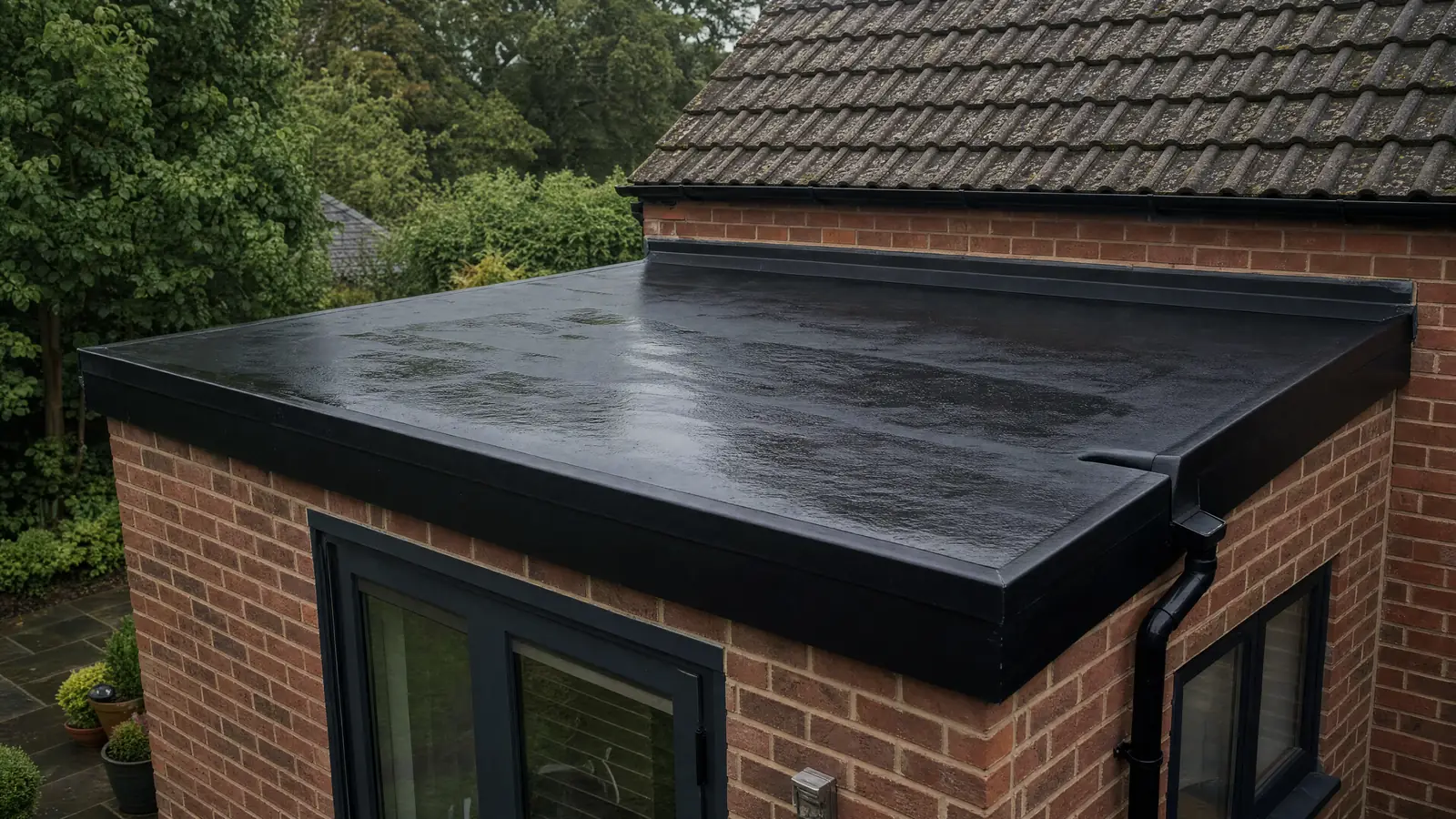
A single sheet of synthetic rubber, usually laid in one piece on a domestic roof so there are no joints at all across the field. Bonded down with adhesive, with formed corners and trims at the edges.
Flexible in cold weather, unaffected by ultraviolet light, and it copes with the movement a timber deck makes through the seasons. Commonly quoted at 25 to 30 years or more on a properly prepared deck. It is the sensible default for a garage or a straightforward extension, and it is what most homeowners should be pricing first.
The weakness is that it is soft. It does not like being walked on with grit underfoot, and it can be punctured. It also relies entirely on the quality of the bonding and the edge trims, so the installer matters more than the material.
GRP fibreglass
Glass fibre matting laid onto a new plywood deck and saturated with resin, then topped with a pigmented coat. It cures into one seamless, hard surface with the upstands and trims formed as part of it.
Hard wearing, walkable, and the right answer for a balcony, a roof terrace or anywhere that gets foot traffic. Commonly quoted at 20 to 30 years. It is also the least forgiving system on this page. It must go on a new deck, it needs the right temperature and dry conditions to cure, and because it is rigid it will crack if the deck below it moves. Excellent when done well, poor when rushed.
Torch-on felt
Modern polyester reinforced bitumen membrane in two or three layers, heat welded together. This is not the felt that ruined the reputation. A good two layer torch-on system is a legitimate, cost effective roof with maybe 15 to 20 years in it, and it is repairable, which the others are less easily.
It is the budget option and it is honest about being one. Where it still makes sense is a large garage, an outbuilding, or a roof you expect to deal with properly in fifteen years anyway. Open flame work near timber and fascias needs a careful operator.
Single ply membrane
PVC or TPO sheet, hot air welded at the seams and either mechanically fixed or fully adhered. This is mostly a commercial system and it comes into its own on larger, more complicated areas. Long lived and light, but it needs welding equipment and a trained installer, so on a domestic garage it rarely beats EPDM on price or sense.
Flat roof guide prices in Peterborough
| Job | Guide range | What moves it |
|---|---|---|
| Single garage flat roof, EPDM | £1,600 to £3,000 | Deck condition, insulation upgrade, edge detailing |
| Extension flat roof, GRP fibreglass | £2,200 to £4,500 | Area, number of upstands, weather at the time of install |
| Extension flat roof, EPDM | £2,000 to £4,000 | Area, upstands, whether the deck is replaced |
| Torch-on felt, single garage | £1,200 to £2,200 | Two layer or three layer, deck condition |
| Dormer roof recover | £1,400 to £3,200 | Access, cheeks and the junction with the main roof |
| Deck replacement, per square metre | £45 to £90 | Added where the boards or joists below are soft |
| Patch repair to an existing flat roof | £250 to £700 | Whether the deck under the failure is still sound |
Guides only, not quotes. Warm deck insulation upgrades, new firrings to correct a fall, and parapet or balcony detailing sit on top of these figures. More detail in the flat roof cost guide.
Falls, drainage and the bits that actually leak
No flat roof is flat. Every one of them should be laid to a fall so water runs off, and the working minimum on domestic work is generally taken as 1 in 80 as a finished fall, which usually means designing to 1 in 40 to allow for deflection and construction tolerance. If a quote does not mention the fall at all on a roof that currently ponds, ask.
Correcting a fall means adding firring pieces, tapered timbers laid along the joists, or using tapered insulation. It adds cost and it is the difference between a roof that lasts and a roof that has a pond on it every winter. On the flat sections of township housing, where the original fall was often marginal to begin with and the joists have deflected since, this is frequently the real job.
Where the water actually gets in
- The upstand against the house wall. The membrane has to turn up the wall at least 150mm and be properly terminated, usually with a lead cover flashing chased into the brickwork. A bead of mastic along the top is not a termination.
- The outlet. One blocked outlet turns the whole roof into a tank. Outlets need clearing, and a flat roof with no overflow provision has no second chance.
- The drip edge and trims. Water needs to get off the edge and into the gutter cleanly rather than tracking back under the roof.
- Anything penetrating the roof. Soil pipes, flues, handrail posts and old aerial fixings. Every penetration is a joint.
This is why the phrase to use with a roofer is not how thick is the membrane but show me how you are detailing the upstand and the outlet. The answer tells you almost everything about whether the roof will still be sound in fifteen years.
Insulation and building regulations
Flat roofing is one of the few areas of roofing where building regulations bite on ordinary domestic work. Where you replace more than half of the surface area of a flat roof, that is generally treated as a renovation of a thermal element and the insulation is expected to be brought up to current standards as far as is reasonably practicable.
In practice that means a quote for a full re-cover should say something about insulation. If it says nothing at all, that is worth a question, because the cost of adding it afterwards is the entire roof again.
If the main pitched roof is being done at the same time, price the two together. Scaffold and set-up costs are shared and the saving is real. See new roofs and re-roofing, and how to choose a roofer for the questions that separate a flat roofing specialist from a general builder who will have a go.
Warm deck against cold deck
A warm deck puts rigid insulation above the deck and below the waterproofing, so the timber stays on the warm, dry side. It is the modern approach, it does not need ventilation, and it is much harder to get wrong. It does raise the roof level, which can matter under a window or against a door threshold.
A cold deck puts insulation between the joists with a ventilated void above it. It works, but the ventilation has to be genuinely continuous and it very often is not, which is how you end up with condensation soaking joists from the inside while the membrane above is perfectly sound. If you have a mysteriously damp flat roof with no visible defect, this is usually why.
Stuffing insulation into an unventilated cold deck void is one of the most damaging things anyone can do to a flat roof, and it gets done regularly by well meaning people trying to warm a cold room.
Ask about the deck before anything else
The single most useful question on a flat roof quote is whether the existing deck is being kept or replaced, and how the firm has established that it is sound.
A cheap quote that keeps a 30 year old chipboard deck is not cheap. It is a new membrane with a two year life expectancy, and the second attempt costs full price.
Related pages
Flat roof costs in detail
Per square metre figures for EPDM, GRP and felt, plus what insulation and deck replacement add.
Read moreRoof leaks
Tracing a leak on a flat roof is a different exercise from tracing one on a pitched roof. Where to start.
Read moreGuttering and fascias
Most flat roof edges drain into a gutter. If the gutter is failing, the roof gets blamed for it.
Read moreFrequently asked questions
As a July 2026 guide including VAT, a single garage in EPDM is typically £1,600 to £3,000, and an extension in GRP fibreglass £2,200 to £4,500.
Replacing a soft deck adds roughly £45 to £90 per square metre, and correcting a fall or upgrading insulation adds more again. Those two items are the usual reason one quote is much higher than another.
For most domestic garages and extensions, EPDM. It is one piece with no seams across the field, it stays flexible in cold weather, and it tolerates the movement a timber deck makes.
GRP is the better answer where the roof gets walked on, such as a balcony or a roof terrace, because it is hard wearing. It is also less forgiving to install, so it depends much more on getting the right contractor and the right weather.
Commonly quoted service lives are 25 to 30 years or more for EPDM, 20 to 30 for GRP, and 15 to 20 for a good two layer torch-on felt system.
Every one of those figures assumes a sound deck, a correct fall and proper edge detailing. Get any of those three wrong and the covering type barely matters.
Often yes, if the failure is local and the deck underneath is still sound. A patch repair typically runs £250 to £700.
If water has been getting in for a while, the deck is usually the real problem, and patching a membrane over a wet chipboard deck simply seals the moisture in. Ask whoever quotes to lift a section and show you. Pitched roof repairs are covered separately on the roof repairs page.
Either it was never laid to an adequate fall, or the joists have deflected over time, or the outlet is blocked. On older extensions and township flat sections it is frequently all three.
Ponding will not necessarily cause an immediate leak, but it accelerates the failure of every material on this page and it finds any weakness in the detailing. It is worth correcting when the roof is next re-covered.
For a like-for-like patch repair, no. Where more than half the surface area is being replaced, the work is generally treated as renovating a thermal element and the insulation is expected to be improved as far as reasonably practicable.
A competent firm will raise this in the quote. If your quote is silent on insulation for a full re-cover, ask the question before you accept it.
Get quotes from Peterborough roofers
Tell us your postcode and what needs doing. We pass it to vetted roofing firms covering that part of Peterborough, and they come back to you directly with quotes.
- Takes about a minute
- No cost to you, ever
- You choose who to speak to, and you can say no to all of them
Compare Peterborough roofers
Answer four questions. We pass your job to vetted roofers who cover your postcode, and they come back to you with quotes. No charge, no obligation.
We pass your details only to roofing firms that cover your postcode, so they can quote. We never sell your details on for other purposes. See our privacy notice.
Find out what your roof should cost
Compare quotes from vetted Peterborough roofers, or call us and we will point you at the right sort of firm for the job.