Costs · updated July 2026
Flat roof cost in Peterborough
What each system costs per square metre and per job here, how long each one really lasts, and the honest way to compare them.
These are guide ranges, not quotes
Every figure here is a researched guide range for Peterborough as at July 2026, including VAT. They are not offers or quotations and no roofing firm is bound by any of them. They exist so that when a real number lands in front of you, you already know roughly where it should sit.
We are not roofers. This is a free quote-comparison service operated by Watts Marketing Ltd, so we have no reason to talk a price up. The firms we introduce you to will price your actual roof.
A flat roof is the one part of a house where the cheapest and dearest quotes are often for genuinely different products with genuinely different lifespans. Comparing totals tells you little. Comparing what each costs per year of life tells you almost everything, and there is a table below that does exactly that. Five systems cover nearly all domestic work here, and they are not interchangeable.
- Torch-on felt. Bitumen membrane heat bonded on site. The cheapest proper system and still the most common on garages.
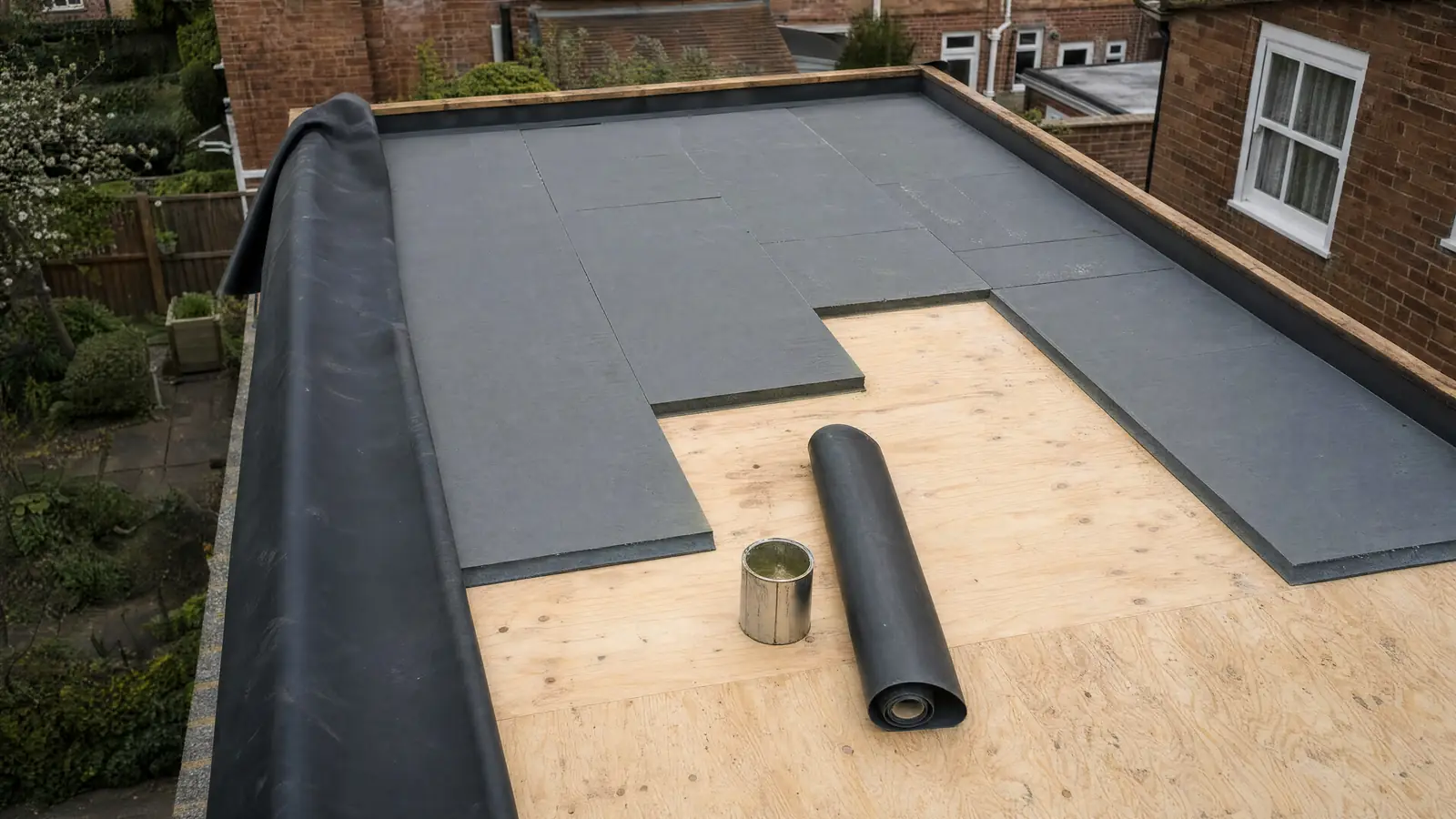
- EPDM rubber. A single sheet of synthetic rubber bonded down, usually with no joins at all on a domestic roof.
- GRP fibreglass. Resin and matting laid wet and cured into one rigid shell. Walkable, but temperature dependent to lay and it cracks on a deck that moves.
- Single ply. A factory-made PVC or TPO membrane, hot air welded at the seams. Excellent on a large simple roof.
- Liquid applied resin. Cold applied, so it follows complicated shapes. Useful where there are penetrations and upstands.
Flat roof cost per square metre by system
| System | Guide rate per m² | Realistic life | Best suited to |
|---|---|---|---|
| Torch-on felt, three layer | £70 to £110 | 15 to 20 years | Garages and budget-limited re-covers |
| EPDM rubber, single sheet | £85 to £130 | 25 to 35 years | Garages, extensions and simple dormers |
| GRP fibreglass | £95 to £150 | 20 to 30 years | Balconies, roofs walked on, rigid decks |
| Single ply, PVC or TPO | £110 to £170 | 25 to 35 years | Larger extensions, over about 35 m² |
| Liquid applied resin | £110 to £180 | 20 to 25 years | Penetrations, upstands, odd shapes |
| Warm deck insulation, added to any of the above | £45 to £85 | Matches the covering | Any flat roof over a heated room |
Small roofs run above the top of these bands, because set-up, edge trims, the skip and travel do not shrink with the area. The whole-job figures below allow for that and are what to hold a quote against. Manufacturer life claims are longer than these figures; these are what the systems realistically achieve on domestic roofs here.
Typical whole-job flat roof prices
| Roof | Approximate area | Torch-on felt | EPDM | GRP fibreglass |
|---|---|---|---|---|
| Porch or small canopy | 4 to 7 m² | £700 to £1,200 | £850 to £1,400 | £950 to £1,600 |
| Flat roof dormer | 6 to 12 m² | £1,100 to £1,900 | £1,300 to £2,200 | £1,400 to £2,400 |
| Single garage | 15 to 18 m² | £1,300 to £1,800 | £1,600 to £2,100 | £1,700 to £2,300 |
| Small extension or kitchen | 12 to 20 m² | £1,400 to £2,000 | £1,700 to £2,400 | £2,200 to £3,000 |
| Double garage | 30 to 36 m² | £2,000 to £2,900 | £2,300 to £3,300 | £2,500 to £3,600 |
| Large extension | 25 to 35 m² | £2,200 to £3,000 | £2,500 to £3,300 | £2,900 to £3,600 |
Where the deck is not sound, add £500 to £900 on a garage or £600 to £900 on an extension or dormer, which keeps a garage in EPDM and an extension in fibreglass inside the ranges on our roofing costs hub. Where the deck, the falls and the insulation all have to be replaced you are building a new flat roof rather than re-covering one, and it should be quoted as such rather than held against these figures. Scaffold is rarely needed at ground level but is normally required on a dormer, at £450 to £900 for one elevation. Above about 35 m² you are into single ply territory.
Cost per year of life, the only honest comparison
Nobody buys a flat roof once. You buy it every time it fails, so the number that matters is what it costs per year until it needs doing again. Worked on a single garage at the middle of each range above, the ranking flips.
| System | Mid-range job price | Realistic life | Cost per year |
|---|---|---|---|
| Torch-on felt, three layer | £1,550 | 18 years | About £86 |
| EPDM rubber | £1,850 | 30 years | About £62 |
| GRP fibreglass | £2,000 | 25 years | About £80 |
| Single ply | £2,250 | 30 years | About £75 |
| Liquid applied resin | £2,300 | 22 years | About £105 |
Cheapest per year is not automatically right for your roof. GRP costs more per year than EPDM but it is walkable. Felt costs the most per year and is still sensible if you are selling in three years. Single ply gets cheaper per square metre as the roof grows, so on a 60 m² roof this table looks very different. The point is that saving £500 today on a system with twelve fewer years in it is not a saving.
The deck, the falls, and what a cheap re-cover hides
Almost every early failure traces back to something under the membrane rather than the membrane itself. Two questions settle most of it before you accept a quote.
Is the deck sound
If the boards are soft, springy or stained, they go back down under a new covering only if somebody is cutting a corner. A membrane laid over a wet deck will fail, and the guarantee will not survive the argument about why.
Are the falls right
A flat roof is not flat. It needs a designed fall so water leaves, commonly built at around 1 in 40 so that after deflection there is still at least 1 in 80 left. Standing water, which roofers call ponding, is the most common reason a flat roof dies young, and it is nearly always a design fault rather than a product fault.
Correcting a fall means firring strips on a new deck, which is why the cheapest quote, the one that re-covers straight over the existing boards, is often the most expensive decision on this page. Where the falls have to be rebuilt too you are replacing the roof, not re-covering it, and it should be quoted as a new flat roof rather than measured against the ranges above.
| Work | Guide cost | Notes |
|---|---|---|
| New 18mm WBP plywood deck | £35 to £55 per m² | The usual spec under EPDM, GRP and single ply |
| New OSB3 deck | £28 to £45 per m² | Cheaper, accepted under some systems, not all |
| Firring strips to create or correct a fall | £12 to £25 per m² | The fix for ponding. Needs a new deck |
| Replace rotten joists | £45 to £90 per metre | Cannot be priced until the deck is off |
| Complete new deck, single garage | £500 to £900 | Roughly 15 to 18 m², including disposal |
| Complete new deck, extension or dormer | £600 to £900 | Roughly 12 to 25 m², including disposal |
| New rainwater outlet and connection | £150 to £350 | Often the cheapest thing that prevents a failure |
A good quote gives you a rate and an allowance rather than silence, and a phone call before anything beyond it is done.
Insulation and building regulations
This surprises people, and it is not optional. Under the building regulations, replacing more than half the surface area of a flat roof over a heated room counts as renovating a thermal element, so the insulation normally has to come up to current standards. The figure usually applied is a U-value of 0.18 W/m²K. Building control will confirm what applies, and that conversation belongs before you accept a quote.
In practice that means insulation boards above the deck, typically 120 to 150mm of rigid PIR, which is what a warm deck is. Budget £45 to £85 per square metre on top of the covering, roughly £550 to £1,400 on a small extension. It has physical consequences too.
- The roof gets 120 to 150mm taller, so upstands, abutment flashings and any door threshold onto the roof all have to be re-set.
- A window or door head close to the roof line can become tight. Far cheaper to find now than halfway through.
- A cold deck, with insulation between the joists and a ventilated void above, is the old way. It is harder to get right, needs continuous cross ventilation, and is why many 1980s flat roofs rotted from the inside.
- A detached unheated garage is not a thermal element, so none of this applies. An integral garage with a heated room against it may be a different matter.
Allow for a building control fee too, separate from the roofer's quote and normally a few hundred pounds. Ask who is notifying building control and get the answer in writing, because a flat roof done without it becomes a problem at the point of sale. If the roof is visible and you are in one of the eight city conservation areas or the 21 village ones, check the appearance question too. See conservation areas and listed buildings.
Why so many flat roofs fail early
Flat roofs have a bad reputation they mostly earned, but they earned it in four specific ways and each is avoidable at the quoting stage.
1. The falls were never right
Water that cannot leave sits there, and standing water shortens every system on this page. If your roof ponds, a re-cover that does not touch the falls buys the same failure again on a newer membrane. Ask what the roofer intends to do about the falls, and treat no answer as an answer.
2. Failure is nearly always at the edges
Very few flat roofs fail in the middle. They fail where the membrane meets something else: an upstand, a parapet, a rooflight kerb, a soil pipe, the outlet. It should be dressed up at least 150mm at every upstand and terminated into a proper flashing or chased into the brickwork, not stuck to the wall and left. Look at the corners and edges, not the field.
3. The wrong system for the job
GRP is rigid, so it cracks on a deck that moves. EPDM is superb and cheap per year of life but does not love foot traffic, so it is the wrong answer under a roof terrace. Single ply is excellent on a large simple roof and pointless on a porch. Most early failures are a good product on the wrong roof rather than a bad product anywhere.
4. The weather it went on in
Fibreglass is the one to watch. The resin cures by chemical reaction and the cure is temperature dependent, so it should not be laid in cold or damp conditions. Peterborough sits on the fen edge, flat and wind-exposed, with a short winter working window, so a GRP roof rushed on in November is a real risk. A firm that would rather wait a fortnight for the weather knows what it is doing.
For the work rather than the price see flat roofing, and for every other job see roofing costs. Read how to choose a roofer, then compare quotes from firms that cover your postcode.
Frequently asked questions
For a simple domestic roof with few penetrations, EPDM is the default on cost per year of life. GRP wins where the roof gets walked on, and it is the one to choose for a terrace or balcony. Single ply wins once the roof is large. Felt wins on price today and nothing else.
The right question is not which is best in the abstract, but which suits this deck, this shape and this many years of ownership. A single garage takes one to two days to re-cover and a small extension two to three, plus a day if the deck is being replaced.
Sometimes, with felt over felt, and it is usually a false economy. You are adding weight, hiding whatever is wrong underneath and guaranteeing the falls stay as bad as they were. Most manufacturers will not warrant their system over an existing covering, which tells you what they think of it.
If you are replacing more than half the surface of a flat roof over a heated room, yes, because that counts as renovating a thermal element and triggers an insulation upgrade. Structural work to the deck or joists is notifiable too. A detached unheated garage generally is not.
If in doubt ask Peterborough City Council building control before the work rather than after, because fixing this at the point of sale is expensive.
Usually one of four things is missing: deck replacement, the insulation upgrade, correcting the falls, or proper edge trims and upstand detailing. Occasionally it is a cheaper system quoted against a dearer one without saying so.
Ask each firm to name the system, the deck specification, the insulation and the guarantee. Compared like for like, honest quotes cluster much closer together than people expect.
Two different things get called a guarantee. The manufacturer's product warranty covers the membrane and is often long, but only pays for material. The installer's workmanship guarantee covers the part that actually fails, because on a flat roof nearly every failure is workmanship or design.
Ask for both in writing, and ask whether the workmanship guarantee is insurance backed.
A fall that is too shallow, a fall running the wrong way, a deck that has deflected between joists, or an outlet that is not at the lowest point. It is almost never the membrane's fault. Puddles that clear within a day or two are normal; water still sitting there in dry weather is not.
Get quotes from Peterborough roofers
Tell us your postcode and what needs doing. We pass it to vetted roofing firms covering that part of Peterborough, and they come back to you directly with quotes.
- Takes about a minute
- No cost to you, ever
- You choose who to speak to, and you can say no to all of them
Compare Peterborough roofers
Answer four questions. We pass your job to vetted roofers who cover your postcode, and they come back to you with quotes. No charge, no obligation.
We pass your details only to roofing firms that cover your postcode, so they can quote. We never sell your details on for other purposes. See our privacy notice.
Find out what your roof should cost
Compare quotes from vetted Peterborough roofers, or call us and we will point you at the right sort of firm for the job.