Roofing services
Chimney repairs in Peterborough
A stack is a few square feet of a roof and the source of a startling proportion of the leaks blamed on the rest of it.
Why the chimney is usually the culprit
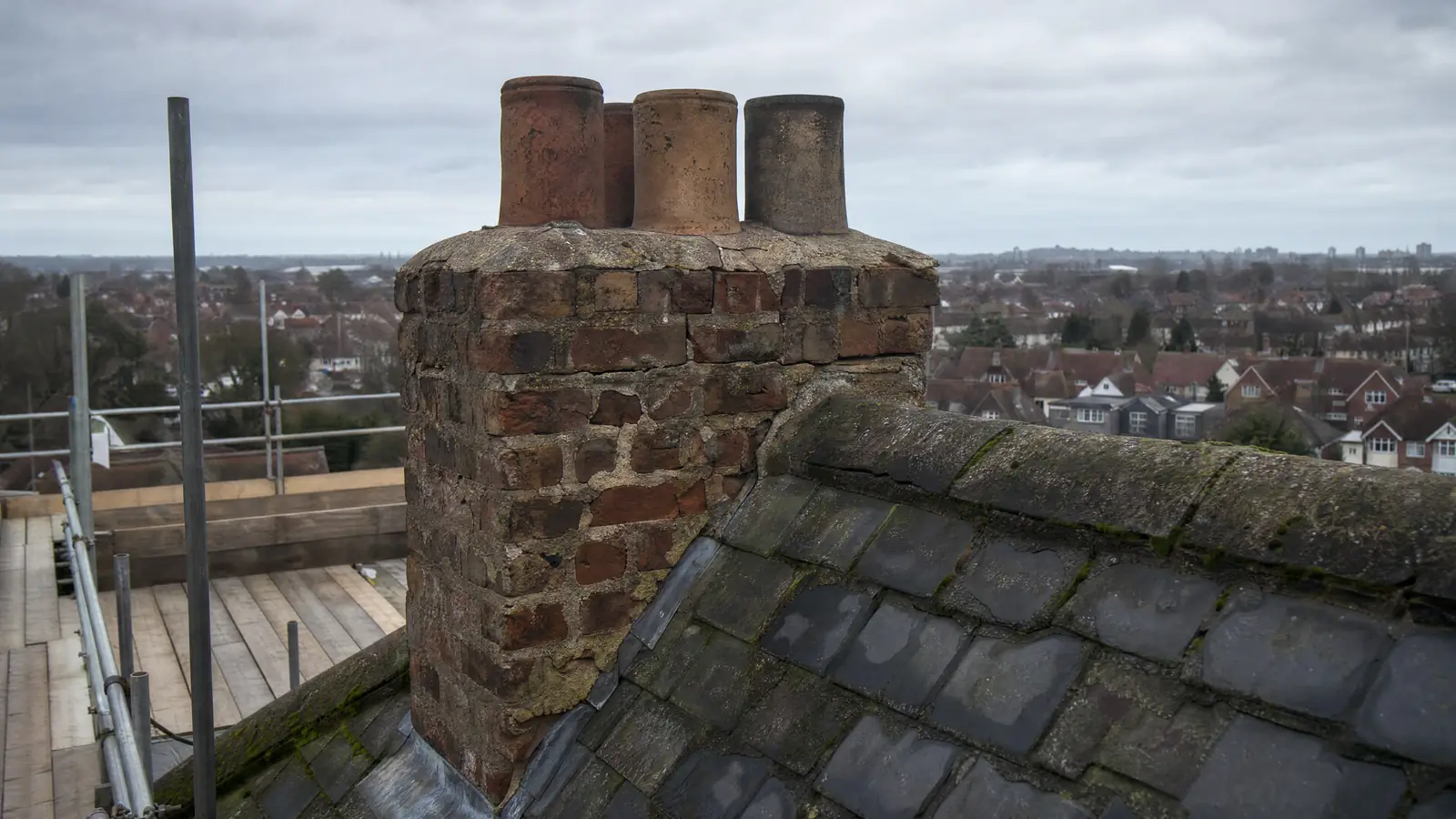
A chimney stack is the most abused part of a house. It stands proud of the roof with no shelter, it is exposed on four sides, it is built of brick and lime or cement mortar that has been sitting in the weather for a century in some parts of the city, and it has been heated and cooled from the inside for most of that time.
That is particularly true of the tall Victorian and Edwardian stacks on the railway terraces around Millfield and New England, many of which have never been repointed.
A stack also creates the single most complicated waterproofing detail on a domestic roof. The junction between a stack and a pitched roof needs a front apron, stepped flashing up both sides, soakers under the tiles or slates, and either a back gutter or a saddle behind it. That is five separate pieces of leadwork, each of which has to be correct, on a structure that is moving slightly relative to the roof.
If you have a damp patch anywhere near a stack, or a stain on a chimney breast in an upstairs room, start here rather than assuming the tiles. Our roof leaks guide explains why stack leaks so often show up in the wrong place.
The five failure points, in the order they usually go
- The flaunching. The sloped mortar cap on the top of the stack that holds the pots in. It is thin, it is horizontal, it takes all the weather and it cracks first.
- The pointing. Mortar joints erode, particularly on the prevailing weather face. Once they are open the brickwork saturates and the damp travels down inside the stack.
- The flashings. Lead lifts out of its chase, mortar fillets crack out, or somebody has replaced proper leadwork with cement or flashing tape at some point in the past.
- The bricks themselves. Saturated brick plus frost equals spalling, where the face of the brick blows off. Once several courses have gone, repointing is no longer the answer.
- The stack leaning. Sulphate attack from decades of flue gases expands the mortar on one side and the stack develops a lean. This is a rebuild, not a repair, and it is a safety matter.
The repairs, and what each one actually fixes
Re-flaunching
The old mortar cap is cut off, the pots are re-set and a new flaunching is formed with a good fall so water runs off rather than sitting. It is a small job with a big effect, because a cracked flaunching lets water straight into the top of the stack where it has the whole height of the chimney to work down through.
Very often this and new flashings together fix a leak that has been blamed on the roof for years.
Repointing
Raking out the old mortar joints to a proper depth and refilling them. The depth matters: a superficial smear of new mortar over old joints, sometimes called buttering or bagging, looks fine for a season and then falls off in sheets.
The mortar mix matters more. On older, softer brickwork a hard cement mortar is worse than no repointing at all, because it is stronger than the brick and forces moisture to escape through the brick face instead of the joint, which accelerates spalling. On a period property, particularly in one of the conservation areas, a lime mortar is usually the correct answer and a firm that does not raise this is not the firm you want.
Flashings
New lead, dressed and wedged into a chased mortar joint and pointed. Code 4 lead is the usual domestic specification for flashings. Done properly it will outlive the rest of the roof.
What you are looking to avoid is the cheap version: a fillet of cement mortar run down the junction, or self adhesive flashing tape. Both crack or peel within a few years, and both have to be removed before the proper repair can be done, so the cheap fix costs you twice.
Rebuilding above the roof line
Where the brickwork has spalled badly or the stack has started to lean, the section above the roof is taken down and rebuilt, reusing sound bricks where possible and matching them where not. New flashings go in as part of the same job, because the leadwork has to come out to do it.
Capping a disused stack
If the fireplace is gone and the flue is redundant, the stack still needs to keep rain out and still needs to breathe. The correct answer is a vented cap or a capping pot that stops rain entering while allowing air movement through the flue.
Sealing a flue completely at the top and at the bottom is a reliable way to produce damp staining on the chimney breast in the room below, because any moisture in the brickwork now has nowhere to go. A surprising number of mystery damp patches on upstairs walls are exactly this.
Chimney repair guide prices in Peterborough
| Job | Guide range | What moves it |
|---|---|---|
| Replace lead flashing to a chimney | £350 to £850 | Stack size, scaffold, and the state of the brickwork behind it |
| Re-flaunch and re-set pots | £300 to £700 | Number of pots, stack height, scaffold or tower access |
| Chimney repointing | £600 to £1,600 | Height, scaffold, extent of the pointing and the mortar specification |
| Rebuild the stack above roof level | £1,400 to £3,500 | Number of courses, brick matching, new flashings included |
| Cap a disused stack, vented | £250 to £600 | Access, and whether the flaunching is renewed at the same time |
| Chimney removal to below the roof line | £900 to £2,200 | Scaffold, making good the roof, structural checks and support |
| Full chimney removal to ground | £2,000 to £5,000 | Internal making good, structural support, plastering and disposal |
Guides only, not quotes. Scaffolding is frequently the largest single line on a chimney job, which is why doing chimney work at the same time as a re-roof or guttering replacement is so much cheaper than doing it on its own. See the roof repair cost guide and the full Peterborough cost table.
Removing a stack is a structural decision
Taking a chimney down is a popular job. It removes a maintenance liability, it frees up floor space and it takes a weak point out of the roof. It is also the chimney job most often done badly, because it is not really a roofing job at all.
The critical point is that a chimney breast and stack are usually load bearing masonry and they frequently provide lateral restraint to a gable or party wall. Cutting out a section in the middle and leaving the part above unsupported is dangerous, and it happens.
- Removal is building regulations work. Removing a chimney breast or stack requires building control approval, and the structural support arrangement needs to be agreed rather than improvised.
- Anything left above must be supported. If you remove the breast downstairs but leave the stack in the loft, the remaining masonry has to be carried on gallows brackets or a beam, designed for the load.
- A shared stack means a shared decision. On a terrace or a semi the stack often straddles the party wall, which makes it a party wall matter and your neighbour's business as much as yours.
- The roof has to be properly closed. Removing to below the roof line means new rafters, battens, underlay and tiling across the hole, matched to the existing covering, not a sheet of something laid over the gap.
- Think about the flue you are losing. If a boiler, a stove or a ventilation route uses it, that has to be dealt with first.
The other consideration is aesthetic and it is worth a moment's thought. On a Victorian terrace, a run of matching stacks is part of what the street looks like, and taking one out of the middle is noticeable. In a conservation area it may not be permitted at all. Check before you budget for it.
Related pages
Roof leaks
Why the wet patch is rarely under the hole, and how to work out whether the stack or the tiles are responsible.
Read moreRoof repairs
Everything else that fails on a pitched roof, with guide prices and the point where repairing stops paying.
Read moreConservation areas
Removing or altering a stack in a conservation area or on a listed building is a different conversation.
Read moreFrequently asked questions
As a July 2026 guide including VAT, £600 to £1,600 for a domestic stack. The spread is mostly access: a stack you can reach off a tower costs far less than one that needs a full scaffold.
If a re-roof or a guttering job is happening anyway, get the chimney priced at the same time. The scaffold is the expensive part and it is already there.
Because the stack has five separate things that can let water in and the roof around it has one. Cracked flaunching, open pointing, failed lead flashings, spalled brickwork and a missing back gutter are all common.
Damp appearing on a chimney breast in a bedroom, or a stain that comes and goes with the wind direction, is a classic stack signature rather than a tile problem.
If the flue is genuinely redundant and the stack is in poor condition, removal to below the roof line is often the cheaper long term answer at £900 to £2,200 as a guide, against repointing and rebuilding costs that can approach the same figure.
It is building regulations work and it can be a party wall matter, so it needs doing properly. In a conservation area it may not be permitted. Capping a sound stack with a vented cap is the cheap middle option at £250 to £600.
Cap the top against rain, yes. Seal it completely, no.
A flue needs air movement through it or moisture in the brickwork has nowhere to go, and it comes out as damp staining on the chimney breast in the room below. Use a vented cap at the top and leave a vent at the bottom.
The sloping mortar cap on top of the stack that beds the pots in and sheds water off the top. It is thin, exposed and horizontal, so it is usually the first thing on a chimney to crack.
Re-flaunching runs £300 to £700 as a guide and it is one of the highest value small jobs on a roof, because a cracked flaunching lets water into the top of the stack where it has the whole chimney to travel down.
For anything beyond a quick inspection, usually yes. Working at height on a stack requires a safe platform, and a scaffold or a chimney scaffold is the standard answer.
This is why chimney work looks expensive relative to the amount of brickwork involved, and why bundling it with other roof work saves real money.
Sudden damage, such as a stack brought down or cracked by a storm or an impact, is normally covered. Gradual deterioration of mortar and brickwork is wear and tear and normally is not.
Photograph everything and contact the insurer before permanent work starts if you think a storm is responsible. Our storm damage guide sets out the order to do things in.
Get quotes from Peterborough roofers
Tell us your postcode and what needs doing. We pass it to vetted roofing firms covering that part of Peterborough, and they come back to you directly with quotes.
- Takes about a minute
- No cost to you, ever
- You choose who to speak to, and you can say no to all of them
Compare Peterborough roofers
Answer four questions. We pass your job to vetted roofers who cover your postcode, and they come back to you with quotes. No charge, no obligation.
We pass your details only to roofing firms that cover your postcode, so they can quote. We never sell your details on for other purposes. See our privacy notice.
Find out what your roof should cost
Compare quotes from vetted Peterborough roofers, or call us and we will point you at the right sort of firm for the job.