Roofing services
Roof tiling and slating in Peterborough
The covering decides the price, the lifespan and, in a conservation area, whether you get to choose at all.
Work out what you have first
Before anybody prices anything, it helps to know what is on the roof. It changes the cost, the specialist you need and sometimes the legal position.
- Large tiles with a wavy or ribbed profile and a visible interlock down each side. Concrete interlocking tile. This is most of the township housing across Bretton, the Ortons and Werrington, and most of Hampton.
- Small flat rectangular tiles, heavily overlapped, in a warm red or brown. Plain tiles, clay or concrete. Roughly 60 tiles per square metre against about 10 for interlocking, which is why they cost so much more to lay.
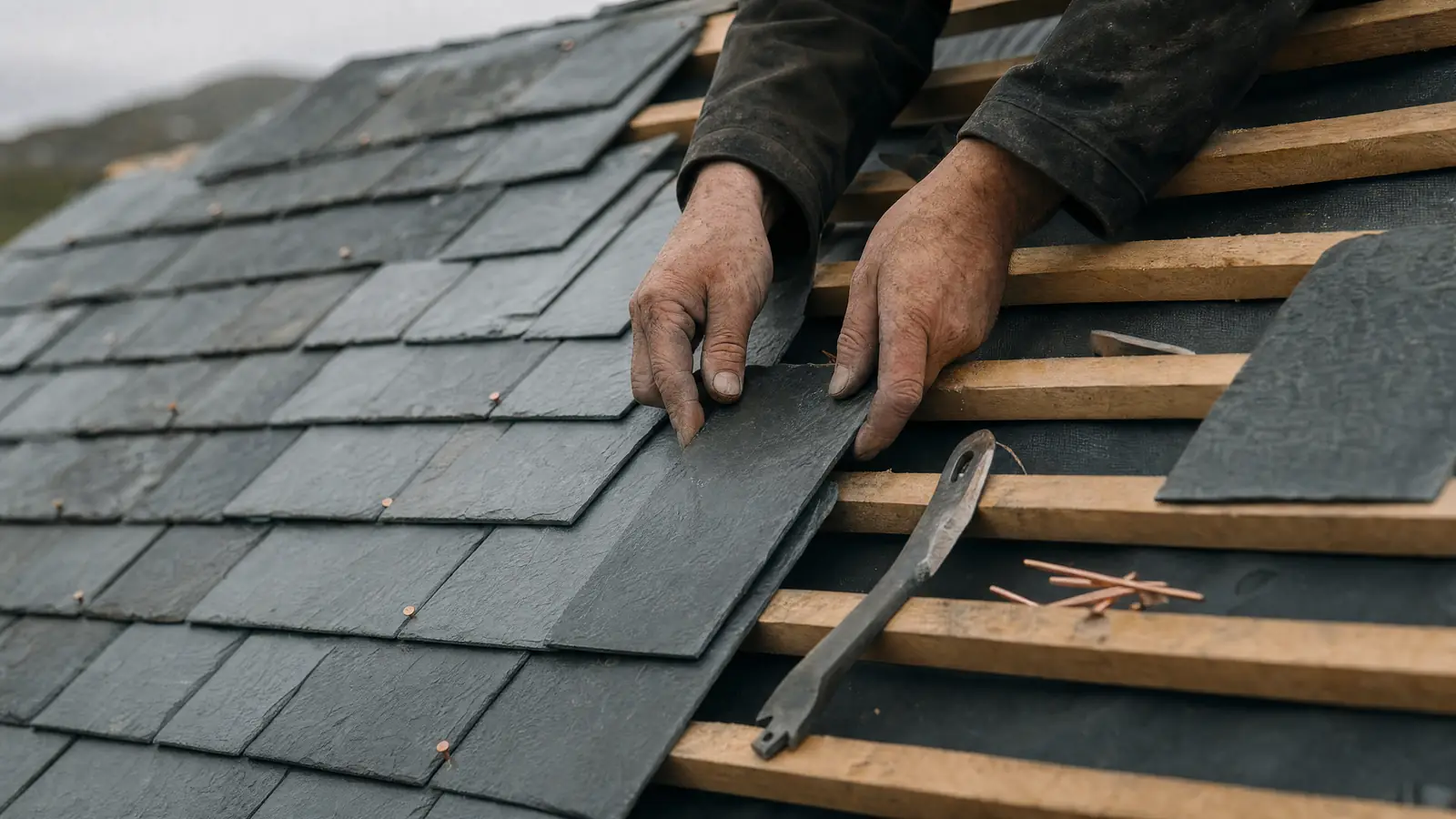
- Thin, flat, grey and uniform, all the same size. Natural slate, or a reconstituted or fibre cement slate imitating it. Common on the Victorian and Edwardian terraces around Millfield and New England.
- Thick, irregular, buff or grey stone, laid in courses that get smaller as they go up the roof. Collyweston stone slate, and this is a specialist job. Do not let a general roofer near it.
If you cannot tell, photograph the roof from the ground and from an upstairs window opposite. Any competent roofer will identify it from a clear photograph, and so will we if you send it with your enquiry.
The coverings, and what each is actually good at
Concrete interlocking tile
Cheap per square metre, fast to lay, and structurally heavy. Commonly quoted at 40 to 60 years. Its real weakness is not strength but surface: the coloured coating weathers off, the tile goes porous, and a porous concrete tile holds water and grows moss. Colour fade is cosmetic. Delamination, where the surface flakes away and the aggregate shows through, is the end of the tile.
Concrete and clay plain tile
Small format, double lapped, and a much better looking roof. Clay holds its colour where concrete fades, and it comfortably outlasts it. The penalty is quantity: six times as many tiles per square metre means six times the handling and fixing, so the labour line goes up sharply even before the material does.
Clay pantiles, the S-shaped profile, sit somewhere between the two on coverage and turn up on a scattering of older properties around the city and the villages.
Natural slate
The longest lived of the mainstream coverings and the standard on the Victorian railway terraces. A well laid slate roof outlives the fixings holding it, which is why the classic failure is nail sickness rather than the slate itself wearing out.
Not all slate is equal. Welsh slate and good imported Spanish slate are different products at different prices, and cheap imported slate with high pyrite content can rust and split within a couple of decades. Ask for the source and the grade in writing, not just the word slate.
Reconstituted and fibre cement slate
Manufactured products designed to look like slate for considerably less money. From the ground, a good one is convincing. They are lighter than natural slate, easier to lay, and they come with manufacturer guarantees worth reading properly, because the length of the guarantee and what it actually covers are two different questions.
In a conservation area or on a listed building they are usually not acceptable, so check before you fall in love with the price.
Collyweston stone slate
A fissile Jurassic limestone quarried at Collyweston in Northamptonshire, roughly 12 miles from Peterborough, and historically used on almost every building within about ten miles of the quarries. That takes in Wansford, Thornhaugh, Barnack, Pilsgate, Southorpe, Ufford, Bainton, Helpston, Castor, Ailsworth and Marholm.
It is laid in diminishing courses, largest slates at the eaves and smallest at the ridge, double lapped, traditionally pegged to riven laths with lime mortar torching underneath. When one of these roofs fails it is almost always the fixings, the pegs and the laths, rather than the stone, which means a careful strip and relay reusing the original slates is often the correct repair.
The wrong repairs are cement mortar, spray foam and bituminous coatings. All three trap moisture and all three prevent the slates from ever being reused. The full story, including why the material nearly disappeared, is in the Collyweston stone slate guide.
Coverings at a glance
| Covering | Commonly quoted life | Where it turns up in Peterborough | Relative cost |
|---|---|---|---|
| Concrete interlocking tile | 40 to 60 years | Township housing across Bretton, Orton, Werrington and Hampton | Lowest |
| Concrete plain tile | 40 to 60 years | Selected estates and rear elevations | Low to medium |
| Clay plain tile | 60 years plus | Older city properties and village housing | Medium to high |
| Natural slate | 80 to 100 years plus | Victorian and Edwardian terraces, Millfield and New England | High |
| Reconstituted or fibre cement slate | 30 to 50 years | Modern estates and slate-look replacements | Medium |
| Collyweston stone slate | Centuries if maintained | The western conservation villages | Highest, specialist only |
Full re-roof guide ranges for Peterborough as at July 2026, including VAT, run from £5,500 to £9,500 for a terraced house up to £9,500 to £20,000 for a detached, with the covering choice a large part of where you land in that range. See the new roof cost guide.
Matching existing tiles, which is the hard part
On a repair or a single elevation re-cover, finding tiles that match is frequently harder than the roofing. Profiles get discontinued. Manufacturers change their colour ranges. A tile that has sat on a Bretton roof since 1972 has weathered into a colour that no new tile will ever be.
There are three honest routes and one dishonest one.
- Reclaimed tiles. Salvage yards hold old profiles and the weathering matches because they are the same age. This is the best answer for a visible elevation. Check the reclaimed tiles are sound, not just old.
- Borrow from the back. Take matching tiles from a rear or hidden elevation for the visible repair, and put the new tiles where nobody sees them. Standard practice and completely legitimate.
- Nearest current equivalent. Accept that the repair will show for a few years and will blend as it weathers. Fine on a rear elevation, less good on a front.
- Painting the new tiles to match. Not a route. It looks wrong within two winters and it is a marker of a firm cutting corners.
If a roofer tells you the profile is obsolete and the whole elevation has to come off, that is sometimes genuinely true and sometimes a convenient upsell. Ask what they searched, ask whether reclaimed stock exists, and get a second opinion before agreeing to a re-cover you were not expecting. The guide ranges on the roof repair cost page and the scope of a proper repair on the roof repairs page will tell you quickly whether you are being sold a bigger job than you have.
Dry fix, and why it matters more here than in a sheltered town
Traditionally the ridge, hip and verge tiles were bedded in sand and cement mortar. Mortar is not a fixing, it is a bedding, and after two or three decades of frost and thermal movement it cracks and releases. That is the origin of a large share of the repairs quoted in this city.
The current British Standard for slating and tiling requires ridge and hip tiles to be mechanically fixed rather than relying on mortar alone, and the industry's answer is dry fix. A dry ridge system clamps or screws each ridge tile down onto a ventilated roll rather than sticking it on. Dry verge units clip over the gable end tiles. There is no mortar to crack and no repointing to pay for in fifteen years.
Peterborough sits on the fen edge, which means flat, open country and very little to slow the wind down before it reaches a gable. Exposed verges and long ridges here take a hammering, and it is the single most persuasive argument for paying the extra on a dry system when a roof is being re-covered anyway.
- Dry ridge and dry verge add cost on the day and remove a maintenance item permanently
- Dry ridge rolls also ventilate at the ridge, which helps a cold loft considerably
- Ask whether the quote uses mortar or dry fix, because it is a real price difference and a real performance difference
- Mechanical fixing is not optional on ridges and hips under the current standard, whatever the quote says
One caution. Dry verge units are the wrong answer on a period property in a conservation area, where plastic clipped along a gable looks exactly like what it is. Horses for courses, and the roofers we introduce you to should be steering you rather than defaulting. How to choose a roofer covers how to tell the difference in a conversation.
Related pages
Collyweston stone slate
The heritage covering of the western villages, why ordinary roofers should not touch it, and what proper repairs involve.
Read moreConservation areas
Peterborough has conservation areas across the city and 21 villages. What that means for your material choice.
Read moreNew roof and re-roofing
When a full strip and re-cover is genuinely needed, what happens on strip day, and guide prices by house type.
Read moreFrequently asked questions
Large tiles with an interlock down each side are concrete interlocking. Small flat tiles heavily overlapped are plain tiles, clay or concrete. Thin, uniform grey rectangles are slate or a slate imitation.
Thick, irregular stone laid in courses that get smaller towards the ridge is Collyweston stone slate, which needs a specialist. Send a photograph with your enquiry if you are not sure.
Sometimes, but it is a serious question rather than a cosmetic one. Concrete interlocking tile is substantially heavier than natural slate and the roof structure of a Victorian terrace was never designed for it.
In a conservation area or on a listed building it will usually not be permitted at all. Get the structure assessed and check with the council before you price it.
The nails holding a slate roof corrode away while the slates themselves are still perfectly good. Slates then start slipping from several elevations at once, and they keep coming.
It is the standard end of life for a Victorian slate roof. Once it starts there is no repair that stops it, and the usual answer is a strip and relay, often reusing a high proportion of the original slates.
For performance and maintenance, yes, and the current British Standard requires ridge and hip tiles to be mechanically fixed rather than held by mortar alone. Dry systems also ventilate at the ridge.
For appearance on a period property in a conservation area, mortar bedding with proper mechanical fixing usually looks right where plastic dry verge units do not. Ask for the option that suits the building.
Usually, through reclaimed stock or by moving matching tiles from a hidden elevation to the visible one and putting new tiles at the back.
An exact colour match to a 50 year old weathered tile does not exist as a new product. Anyone promising one is either using reclaimed tiles or overselling.
Yes, without qualification. Collyweston stone slate is laid in diminishing courses and traditionally pegged to laths with lime mortar torching beneath, and it behaves nothing like a tiled roof.
Cement mortar, spray foam and bituminous coatings are the classic wrong repairs. They trap moisture and destroy the slates for reuse, which turns a maintainable roof into a rebuild. See the Collyweston guide.
Get quotes from Peterborough roofers
Tell us your postcode and what needs doing. We pass it to vetted roofing firms covering that part of Peterborough, and they come back to you directly with quotes.
- Takes about a minute
- No cost to you, ever
- You choose who to speak to, and you can say no to all of them
Compare Peterborough roofers
Answer four questions. We pass your job to vetted roofers who cover your postcode, and they come back to you with quotes. No charge, no obligation.
We pass your details only to roofing firms that cover your postcode, so they can quote. We never sell your details on for other purposes. See our privacy notice.
Find out what your roof should cost
Compare quotes from vetted Peterborough roofers, or call us and we will point you at the right sort of firm for the job.