Guides
Roof leaks: why the wet patch is almost never under the hole
Water runs before it drips. Trace it properly and the fix is usually small. Guess at it and you pay twice.
- Water travels
- The real culprits
- Leak, damp or condensation
- Narrowing it down
- Before the roofer arrives
- Why tracing costs money
- Ceiling damage
Water does not fall straight down
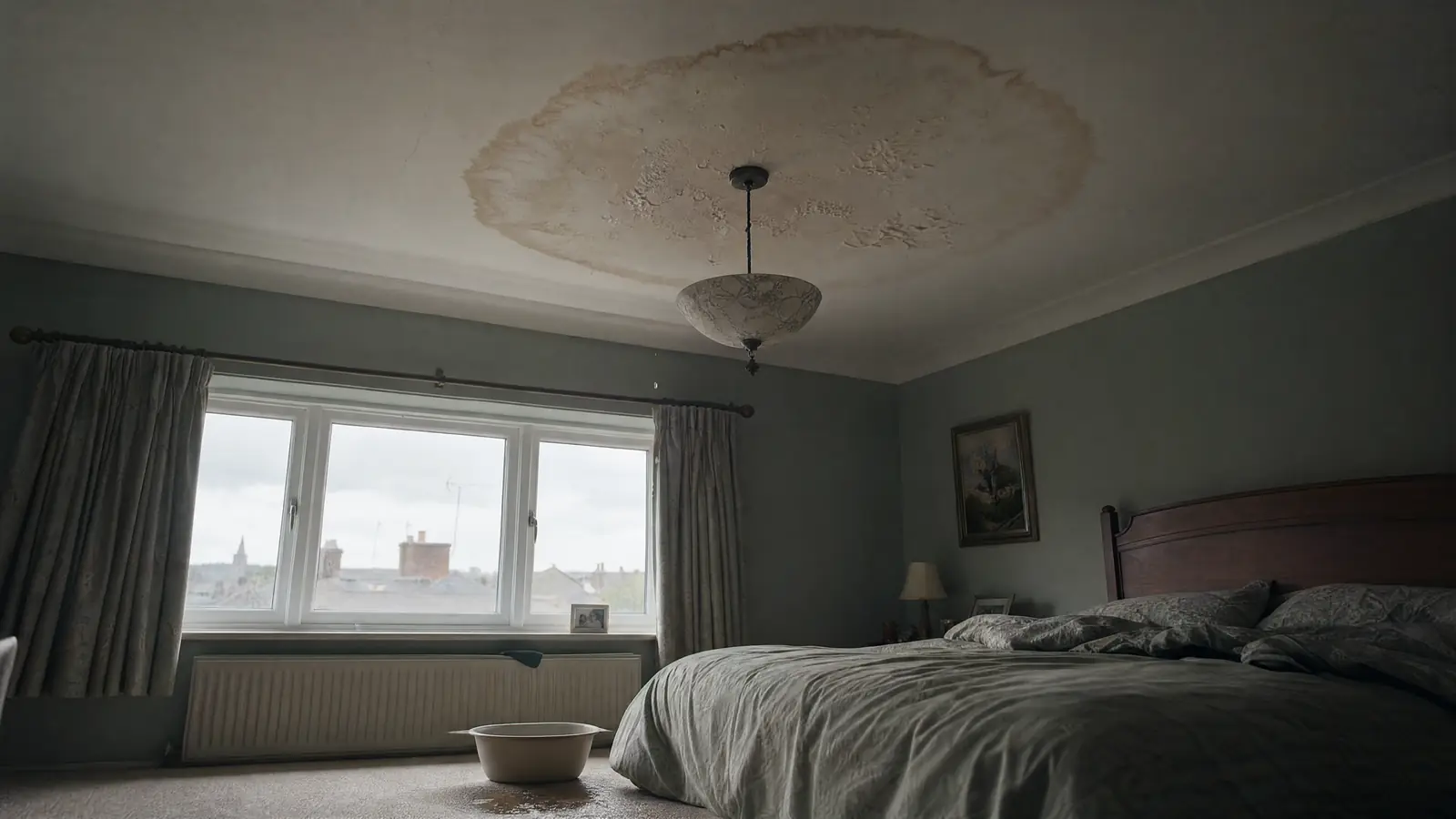
A roof leak has three separate locations and people routinely confuse all three: where water gets through the covering, the path it then takes across felt and down a rafter, and where it finally shows itself on your ceiling. On a pitched roof those points can be three or four metres apart, and the entry point is almost always further up the slope than the stain.
That single fact explains why so many roof repairs fail. Somebody looks at the ceiling stain, goes up, replaces the nearest tile and takes payment. The leak comes back at the next heavy rain because that tile was never the problem.
It also explains why a proper leak trace is worth paying for. The repair is rarely the expensive part. Working out which repair is needed is.
Two questions do most of the work. If there is a chimney, a vent pipe, a dormer or a roof meeting a wall anywhere up-slope of the stain, that is your first suspect rather than the tiles. And if the ceiling is wet when it has not rained, it is very likely not a leak at all.
The real culprits, in the order you should suspect them
Roughly by how often each turns out to be the cause on ordinary Peterborough housing.
1. Chimney flashing and flaunching
Chimneys cause a wildly disproportionate share of the leaks blamed on roofs. One stack has several failure points: the lead flashing where it meets the slope, the step flashing and soakers up the sides, the mortar fillet somebody used instead of lead, the flaunching (the sloped mortar cap the pots sit in) and the pointing itself. Any of them lets water into the brickwork, and a stack is a masonry sponge that feeds it into the roof space.
The tell is a stain near a chimney breast, or damp on the breast itself in an upstairs room. Flaunching in particular cracks with frost and is almost invisible from the ground. More detail in chimney repairs.
2. Valleys
A valley is the internal angle where two slopes meet, carrying a large volume of water down a narrow channel. Anything that slows that water down puts it where it should not be: leaves and moss off an overhanging tree, a split in an old lead or fibreglass valley, mortar debris left after ridge work, or a valley laid too narrow in the first place.
Valleys are common on the township semis and on almost every Victorian terrace with a rear back-addition. A valley leak usually shows as a stain running in a line rather than a single spot.
3. Abutment flashings
Anywhere the roof meets a vertical wall: a rear extension, a porch, a dormer cheek, a garage. The flashing should be lead, dressed into a chased mortar joint and turned down over the tiles. What you often find instead is a mortar fillet smeared into the angle, which cracks within a few years and then funnels water inwards. If the leak is above or near a single-storey extension, look here before anything else.
4. Slipped, cracked or missing tiles and slates
The obvious one, genuinely common, but not usually first. On concrete interlocking tile it is normally a lost nail or clip, or wind lifting a tile at a verge. On Victorian slate it is nail sickness: the nails corrode and the roof starts shedding slates a few a year. On older township roofs it is frequently the ridge and hip mortar rather than the tile field at all.
One slipped tile is a small job. Our guide range for replacing a few slipped tiles is roughly £150 to £350, driven mostly by whether the access needs a scaffold or a tower. See the roof repair cost guide.
5. Felt failure at the eaves
Under the tiles sits felt or a breather membrane, there to catch anything that gets past the covering and carry it into the gutter. The strip at the very bottom of the slope fails first. It perishes with age and UV, and on a lot of 1970s roofs it was never dressed properly into the gutter to begin with.
When it goes, water the covering was always going to let through in a storm stops reaching the gutter and lands on the wall plate instead. The symptom is damp high up on an upstairs external wall rather than a drip in a ceiling, and it gets misdiagnosed as a wall problem constantly. An eaves felt tray is the usual remedy, and it does not need a re-roof.
6. Condensation pretending to be a leak
Under-diagnosed, and it wastes real money. Warm moist air rises into a cold loft, meets the cold underside of the roof and condenses. In a badly ventilated loft that means droplets on the felt, damp insulation, black mould on the rafters and, in a hard winter, drips onto the ceiling below.
It looks exactly like a leak. The differences: it is worst in cold weather rather than wet weather, it is widespread rather than in one spot, the felt is wet on its underside over a large area, and it often starts after somebody vented a bathroom extractor into the loft, boarded over the eaves vents, or topped up the insulation without adding any ventilation.
The fix is ventilation, not roofing. Eaves vents, ridge or tile vents, extractor ducting taken all the way to outside air, and a sealed loft hatch. Replacing tiles will do nothing at all.
Damp, leak or condensation: a rough decision tree
Match the symptom to the most likely cause before anyone quotes you for anything.
| What you are seeing | Most likely | What to do next |
|---|---|---|
| Stain appears or grows only during or just after rain | Roof leak | Note the wind direction and how heavy the rain was, then get a proper trace |
| Worst in driving rain from one direction only | Flashing, verge or wall abutment | Check chimney, dormer and extension junctions before tiles |
| Wet in cold weather, dry in mild wet weather | Condensation in the loft | Check loft ventilation and where the extractor fans actually vent to |
| Damp along the top of an upstairs outside wall | Eaves felt or guttering | Watch the gutter during heavy rain, then look at the felt at the eaves |
| Damp low down on a ground floor wall, no roof link | Rising or penetrating damp | Not a roofing job. A damp survey is the right call |
| Water appears hours after the rain stopped | Something holding water | Blocked valley, blocked gutter, or saturated insulation draining |
A guide, not a diagnosis. Water is genuinely difficult and even good roofers occasionally need two visits.
How to narrow it down yourself, from inside
You do not need to go on the roof, and you should not. Almost all of the useful evidence is available from a loft hatch and a window.
- Go into the loft with a torch during or immediately after heavy rain. The single most useful thing you can do, and the thing most people skip.
- Look up, not down. Find wet timber and follow it uphill. Water tracks along rafters and drips off the lowest point, not the entry point.
- Look for history. Old dried tide marks mean years of this. A single clean wet run means it is new.
- Check the felt from underneath. Wet on top near one point means water is coming through the covering there. Wet underneath over a wide area is condensation.
- Photograph everything, with the date. Wet timber dries out, and the photos are what the roofer works from and what an insurer will ask for.
- Note where it sits relative to the chimney breast, the party wall, the bathroom and any lower roof outside.
- Do not put a bucket under it and move on. That buys time to get it looked at, it does not solve anything.
Stay off the roof
Ladder falls are the most common serious accident in home maintenance and a wet or mossy roof is lethal. There is nothing visible from up there that a roofer with the right access equipment cannot see more safely. If water is coming in now, see emergency roofing.
What to do before a roofer arrives
- Move what matters. Electronics, furniture and anything absorbent, out from under the drip.
- Kill the power to that part of the house if water is anywhere near a light fitting or a socket. Water in a ceiling rose is a genuine electrical risk, not a theoretical one.
- Contain it, but let it drain. A bulging ceiling holding water is more dangerous than a drip. See below.
- Photograph everything, dated, inside and outside from the ground.
- Clear the gutters if that can be done safely, or get someone to. A blocked gutter is behind a surprising number of leaks and costs nothing to rule out.
- Write down the timeline. Which storms, which wind direction, how long after the rain starts. That shortens the trace.
- Do not agree to work before somebody has found the cause. A quote for an undiagnosed repair is a guess with a price on it.
Why the trace can legitimately cost more than the repair
This surprises people, and some assume they are being taken advantage of. Usually they are not. A roofer arriving at a ceiling stain with no obvious cause is carrying out an investigation, not a repair: a tower or scaffold for safe access, a systematic check of every flashing, valley and abutment, tiles lifted in several places, sometimes a hose test with one person on the roof and one in the loft. That is hours of skilled time.
The repair at the end might be twenty minutes of leadwork. A bill where the diagnosis costs more than the cure is not a rip-off, it is what an honest job looks like on a difficult leak.
What is not acceptable is being charged for a trace that never happened. If nobody has been on the roof or in the loft, ask what the diagnosis is based on, and ask what happens if the leak returns. Get that in writing before you agree anything. See how to choose a roofer.
As guide ranges, replacing lead flashing to a chimney sits around £350 to £850 and ridge work around £450 to £1,200. See the roof repair cost guide.
The ceiling: when to worry, and when it is only cosmetic
A brown stain on a plasterboard ceiling is cosmetic. It needs a stain block and paint once everything has dried out fully, and it can wait.
A bulge is not cosmetic. Sagging plasterboard is holding water and can come down in one piece without warning, bringing the water with it. That is a real injury risk, particularly to children and pets.
Never stand under a sagging ceiling
If a ceiling is bulging, keep everyone out of the room and shut the door. Do not push furniture underneath to catch it.
The controlled option is to pierce the lowest point of the bulge from the side, at arm's length, with something on a long handle and a bucket underneath, so it drains rather than collapses. If you are not confident doing that, keep the room shut and tell the roofer it is urgent.
Lath and plaster ceilings, common in the older terraces around Millfield and New England and in the village cottages, behave differently. They soak up a great deal of water and then let go in large heavy sections, so treat one as more serious than the plasterboard equivalent.
Structurally, watch the timber rather than the ceiling. A leak that has run for one winter is a nuisance. One that has run for years soaks the rafter feet and the wall plate, and wet rot in a wall plate is an expensive, scaffolded, disruptive repair. That is the real argument for dealing with a small leak now rather than in the spring.
Repeated leaks in different places on the same roof are a different conversation. The covering is usually finished, and patching it one spot at a time stops making financial sense. Roof repairs sets out where that line sits, and roofing costs lets you compare the two honestly.
When you are ready for someone to look at it, ask for quotes and describe the symptom rather than your diagnosis. Say where the house is too, because a Victorian terrace off Lincoln Road and a township semi in Bretton leak in different places for different reasons.
Frequently asked questions
Go into the loft with a torch while it is raining. Find the wet timber, then follow it up the slope, because water tracks downhill along rafters before it drips. The entry point is above the drip, not under it.
Then look at what sits up-slope of that point outside: a chimney, a valley, a dormer, an extension abutment. That is usually your answer.
Often yes. Physical evidence such as cracked flaunching, a split valley, a mortar fillet instead of lead or a slipped tile is visible in dry weather, and old water staining in the loft shows the path.
Where there is no obvious cause, a hose test can reproduce it, working up the slope in sections with somebody in the loft. That takes time, which is why a leak trace is charged as a job in its own right.
It depends entirely on the cause. As guide ranges, replacing a few slipped tiles is roughly £150 to £350, replacing lead flashing to a chimney £350 to £850, and ridge work £450 to £1,200.
Add the cost of finding it if the cause is not obvious. Those are guide ranges for Peterborough, not quotes, and no firm is bound by them.
If it is worst in cold weather and there is widespread wetness on the underside of the felt across the loft, it is condensation. If it appears during rain and there is a defined wet track on top of the felt or down one rafter, it is a leak.
Condensation is a ventilation problem. Replacing tiles will not touch it, and anyone quoting you for roofing work to solve it has not diagnosed it.
A leak caused by a sudden event such as storm damage is normally covered. A leak caused by a worn out covering, failed mortar or lack of maintenance normally is not, because buildings insurance covers events rather than wear and tear.
The resulting damage to ceilings and decoration is often covered even where the roof repair itself is not, so it is worth asking. Read the policy wording rather than the summary.
Not as long as it feels. A small leak is cheap while it is only wetting felt and one rafter. Once it has soaked the rafter feet and the wall plate over a couple of winters, you are into rot repairs, scaffolding and a much larger bill.
The cost curve on roofing is unusually steep. Almost nothing gets cheaper by being left.
Go back to the firm first, and ask them to return. On a genuinely difficult leak a second visit is not unusual and a decent firm will treat it as part of the job.
If they will not return, or want to charge again for a repair that did not work, that tells you what you need to know about them. Ask before you commit what happens if the leak comes back, and get the answer in writing.
Get quotes from Peterborough roofers
Tell us your postcode and what needs doing. We pass it to vetted roofing firms covering that part of Peterborough, and they come back to you directly with quotes.
- Takes about a minute
- No cost to you, ever
- You choose who to speak to, and you can say no to all of them
Compare Peterborough roofers
Answer four questions. We pass your job to vetted roofers who cover your postcode, and they come back to you with quotes. No charge, no obligation.
We pass your details only to roofing firms that cover your postcode, so they can quote. We never sell your details on for other purposes. See our privacy notice.
Find out what your roof should cost
Compare quotes from vetted Peterborough roofers, or call us and we will point you at the right sort of firm for the job.