Roofing services
New roofs and re-roofing in Peterborough
A full strip and re-cover is the biggest single thing you will ever spend on a house you cannot see. Here is when it is genuinely needed and what it costs.
The honest trigger points
Re-roofing is the job most often sold to people who did not need it yet, and most often delayed by people who needed it two winters ago. The difference between the two is not the age of the roof. It is what is actually failing.
A roof is a system: covering, fixings, underlay, battens, mortar, flashings and timber. Replace the lot and you are re-roofing. Replace any one of them and you are repairing. The question is only ever how many of those seven things are finished at the same time.
Replace the roof when
- Battens are soft or crumbling across the roof, not in one patch. Nothing can be fixed back to rotten timber, so this ends the repair conversation.
- The underlay has torn or perished generally. On pre-1980s bitumen felt this is normal and it cannot be replaced without stripping the covering.
- Concrete tiles are delaminating, going porous or shedding their surface across whole elevations rather than cracking individually.
- A slate roof is losing slates from multiple elevations, which is nail sickness and it only gets faster.
- You have had three or more separate repairs in two years and each one needed access equipment.
Do not replace the roof when
- Somebody knocked on the door and told you it needed doing. Nobody can assess a roof from the pavement.
- The only symptom is moss. Moss is a maintenance question, not a structural one. See roof cleaning.
- One elevation has failed and the other three are sound. A single elevation re-cover is a real option and it is roughly half the price.
- The problem is the chimney, the flashings or the gutters. Those are separate jobs that get blamed on the roof constantly.
- The roof is 30 years old and nothing is wrong with it. Age alone is not a reason.
Why this question keeps coming up in Peterborough
Peterborough was designated a New Town in 1967, and the Peterborough Development Corporation ran from February 1968 to September 1988 with a brief to house an additional 70,000 people, mainly from Greater London. Bretton was the first township, with construction beginning in 1970 on former Milton estate land, and Orton and Werrington followed.
That means a very large share of this city's housing stock was roofed within a fairly narrow window, and it is now roughly 45 to 55 years old. Concrete interlocking tile, which is what most of it was covered in, is commonly quoted at 40 to 60 years of service life, so a lot of township roofs are in the last third of theirs at the same time.
The tiles themselves are often the part with life left. What reaches the end first is the bitumen felt underlay, the nails, and the mortar. That is why so many Bretton and Orton homeowners get told the roof needs doing when the tiles still look perfectly reasonable from the road. It can be true, and it can also be an easy sale. The way to tell is to ask specifically about the battens and the underlay, and to ask for a photo.
Elsewhere in the city the picture is different. The Victorian and Edwardian terraces around Millfield and New England, built in association with the Great Northern Railway, are natural slate and their re-roof economics are nothing like a township house. Hampton, started in 1996, is young enough that a full re-roof there is almost always a detailing or workmanship issue rather than an age one.
New roof guide prices by house type
| House type | Guide range | What moves it |
|---|---|---|
| Full re-roof, terraced house | £5,500 to £9,500 | Covering chosen, roof size, scaffold access, timber found on strip |
| Full re-roof, semi-detached | £7,000 to £13,000 | As above, plus dormers and valleys |
| Full re-roof, detached | £9,500 to £20,000 | Size and complexity, tile choice, chimney work at the same time |
| Single elevation re-cover, semi | £3,500 to £6,500 | Half the tiling, but most of the scaffold and all of the set-up |
| Garage or outbuilding pitched roof | £1,800 to £4,000 | Area, whether the roof structure itself needs work |
Guides only, not quotes, and no roofing firm is bound by them. Conservation area materials, listed buildings and Collyweston stone slate sit well outside these figures. Full detail is in the new roof cost guide.
What actually happens on strip day
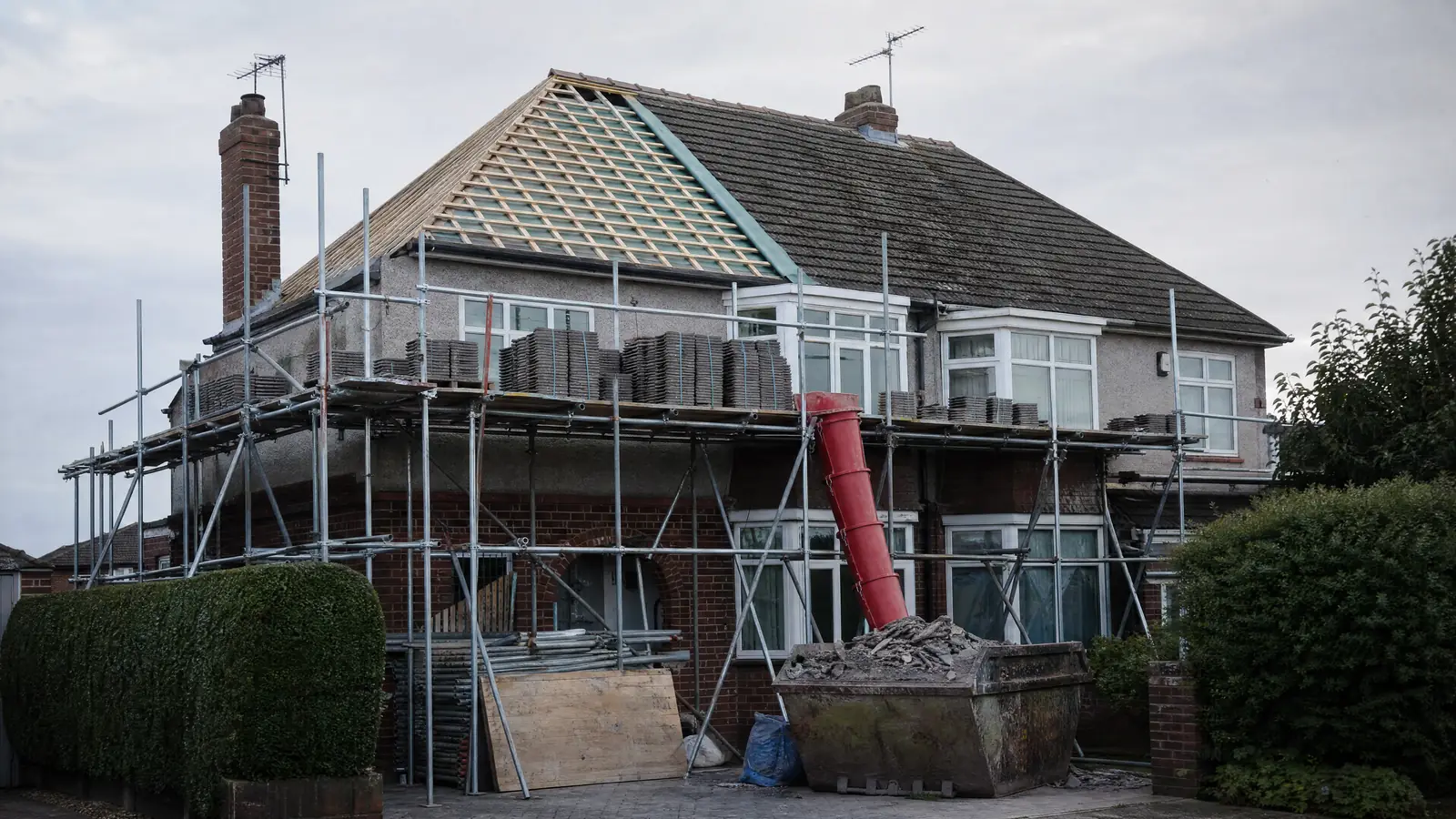
A re-roof on an ordinary Peterborough semi is usually four to seven working days once the scaffold is up. Knowing the sequence makes it much easier to tell whether a job is going properly.
Scaffold goes up first
Normally a day, and often a few days before the roofers arrive. If the scaffold needs to stand on a neighbour's land or on a public footpath, a licence from the council may be needed, and that takes time. Ask who is arranging it.
The covering comes off
Tiles, underlay and battens are stripped, usually one elevation at a time so the house is never fully open. Expect a skip or a grab lorry, expect noise, and expect dust in the loft. Move anything precious out of the loft before they start.
The moment of truth on the timber
With everything off, the rafters are visible for the first time in decades. This is when extra costs appear, and it is the reason your quote must state a rate for replacing rafter ends or adding new timber. Ask to be shown anything they want to charge for.
Underlay, battens and the new covering
Modern breathable underlay, treated battens at the correct gauge for your tile, then the covering laid from the eaves up. Verges, ridges and hips are formed as the work reaches them.
Details, then the scaffold comes down
Flashings, ridge and verge systems, and any leadwork. Good firms sort the gutters and any chimney flashing while the scaffold is still standing, because doing it later means paying for access twice.
Coverings compared
The covering is the single biggest choice you make and it can swing the price of the same roof by a factor of three or more. There is far more detail on the tiling and slating page, but in outline:
- Concrete interlocking tile. The cheapest common option and what sits on most township housing. Large tiles, fast to lay, commonly quoted at 40 to 60 years. Heavy, which matters if the original roof was slate.
- Concrete plain tile. Small format, double lapped, so you need roughly four times as many per square metre and the labour goes up accordingly. Looks considerably better than interlocking.
- Clay plain tile and pantile. Holds its colour where concrete fades, and outlasts concrete comfortably. Costs more, both in material and in labour.
- Natural slate. The longest lived common covering and the standard on the Victorian terraces. Expensive, and it needs a roofer who slates regularly rather than occasionally.
- Reconstituted and fibre cement slate. A sensible middle path where a slate appearance is wanted without natural slate money. Check what the guarantee actually covers.
- Collyweston stone slate. The traditional covering on the western villages and a different world entirely. Do not let a general roofer near it. See the Collyweston stone slate guide.
Changing the covering is not always your choice
A like-for-like re-covering on an ordinary house normally falls under permitted development, though building regulations still apply to the work itself.
In a conservation area, on a listed building, or where you are switching material or altering the roof shape, that changes. Peterborough has conservation areas across the city and in 21 of the surrounding villages. Read the conservation areas guide and check with the council before you commit to a material.
There is also a weight question. Swapping natural slate for concrete tile puts substantially more load on a roof structure that was never designed for it, and a competent firm will raise that with you rather than discovering it afterwards.
What a re-roof quote has to contain
Re-roof quotes vary wildly in what they include, which is exactly why comparing totals is useless. Compare these lines instead.
- Scaffold, including how long it stands and who pays if the job overruns
- Strip and disposal, with skip or grab costs stated rather than assumed
- The covering named by manufacturer, model and colour, not just concrete tiles
- Underlay type and batten grade, both of which are places where money quietly gets saved
- A stated rate for replacement timber if rot is found on strip
- Ridge and verge method, mortar or dry fix, because they cost differently and perform very differently
- New flashings, or a clear note that existing lead is being reused and why that is acceptable
- The guarantee: how long, what it covers, whether it is insurance backed, and who honours it if the firm stops trading
Two quotes that look £3,000 apart often turn out to be about £500 apart once you line up what each of them actually includes. Occasionally they turn out to be £3,000 apart for a good reason, and you want to know which of those situations you are in before you sign anything.
The questions worth asking beyond the paperwork are in how to choose a roofer.
Frequently asked questions
As a guide for July 2026, including VAT: £5,500 to £9,500 for a terraced house, £7,000 to £13,000 for a semi-detached, and £9,500 to £20,000 for a detached house.
Those ranges assume standard coverings and ordinary access. Conservation area materials, a listed building or Collyweston stone slate put the figure somewhere else entirely. See the new roof cost guide for the breakdown.
An ordinary Peterborough semi is usually four to seven working days of roofing, plus scaffold up and down either side of that.
Weather stops tiling and stops mortar work. A firm that gives you a fixed date in February and refuses to move it is either very lucky or about to do something badly.
For a like-for-like re-covering on an ordinary house, usually not. It normally falls under permitted development, though building regulations still apply to the work.
In a conservation area, on a listed building, or where you change the material or the roof shape, the answer can change completely. Check with Peterborough City Council before you commit.
Yes, and a single elevation re-cover is a genuinely common job, particularly on a semi where one side is exposed and the other is sheltered.
It is not half the price, because you still pay for the scaffold, the set-up and the disposal. Expect somewhere around 60 to 65 per cent of the full figure rather than 50.
No. A re-roof is done from outside and the house stays habitable throughout. One elevation is normally stripped and re-covered at a time so the building is never left fully open.
Expect dust in the loft, noise from about 8am, and no parking on your own drive for the duration. Clear the loft before they start.
Rarely worth it purely as an investment. You almost never get the full cost back in the sale price.
What does matter is that a surveyor's report saying the roof is at the end of its life will be used to negotiate the price down, often by more than the roof would have cost. Getting a proper written assessment and having quotes in hand is usually the stronger position.
Re-roofing means the old covering, underlay and battens come off and everything is renewed. Over-boarding or over-tiling means laying new material on top of the old.
On pitched domestic roofs, laying new tiles over old is not a legitimate approach and any firm proposing it should be shown the door. It hides the condition of the timber, adds weight and does nothing about the perished underlay that is usually the actual problem.
Get quotes from Peterborough roofers
Tell us your postcode and what needs doing. We pass it to vetted roofing firms covering that part of Peterborough, and they come back to you directly with quotes.
- Takes about a minute
- No cost to you, ever
- You choose who to speak to, and you can say no to all of them
Compare Peterborough roofers
Answer four questions. We pass your job to vetted roofers who cover your postcode, and they come back to you with quotes. No charge, no obligation.
We pass your details only to roofing firms that cover your postcode, so they can quote. We never sell your details on for other purposes. See our privacy notice.
Find out what your roof should cost
Compare quotes from vetted Peterborough roofers, or call us and we will point you at the right sort of firm for the job.