Guides
Collyweston stone slate roofs: the covering that punishes a general roofer
Fissile Jurassic limestone, split by frost, laid in diminishing courses and pegged to riven laths. Put the wrong firm on one of these and the damage is permanent.
- What it actually is
- How it was won
- How the roof is built
- Why they fail
- Repairs that ruin them
- Scarcity and skills
- Consent and cost
What Collyweston slate actually is
Collyweston slate is not slate. It is a fissile oolitic limestone of Jurassic age, quarried at Collyweston in Northamptonshire, roughly 12 miles from Peterborough. Fissile means it splits naturally along its bedding planes, which is the only reason a block of limestone can become a roofing slate at all. True slate is a metamorphic rock and behaves completely differently.
It has been used as a roofing material since Roman times, and historically covered almost every building within about ten miles of the quarries. That radius is why this is a Peterborough subject rather than a Northamptonshire one: it takes in the villages along the western edge of the district.
Those villages are Wansford, Thornhaugh, Barnack, Pilsgate, Southorpe, Ufford, Bainton, Helpston, Castor, Ailsworth and Marholm. If your property is in one of them and the roof is stone, this page applies to you.
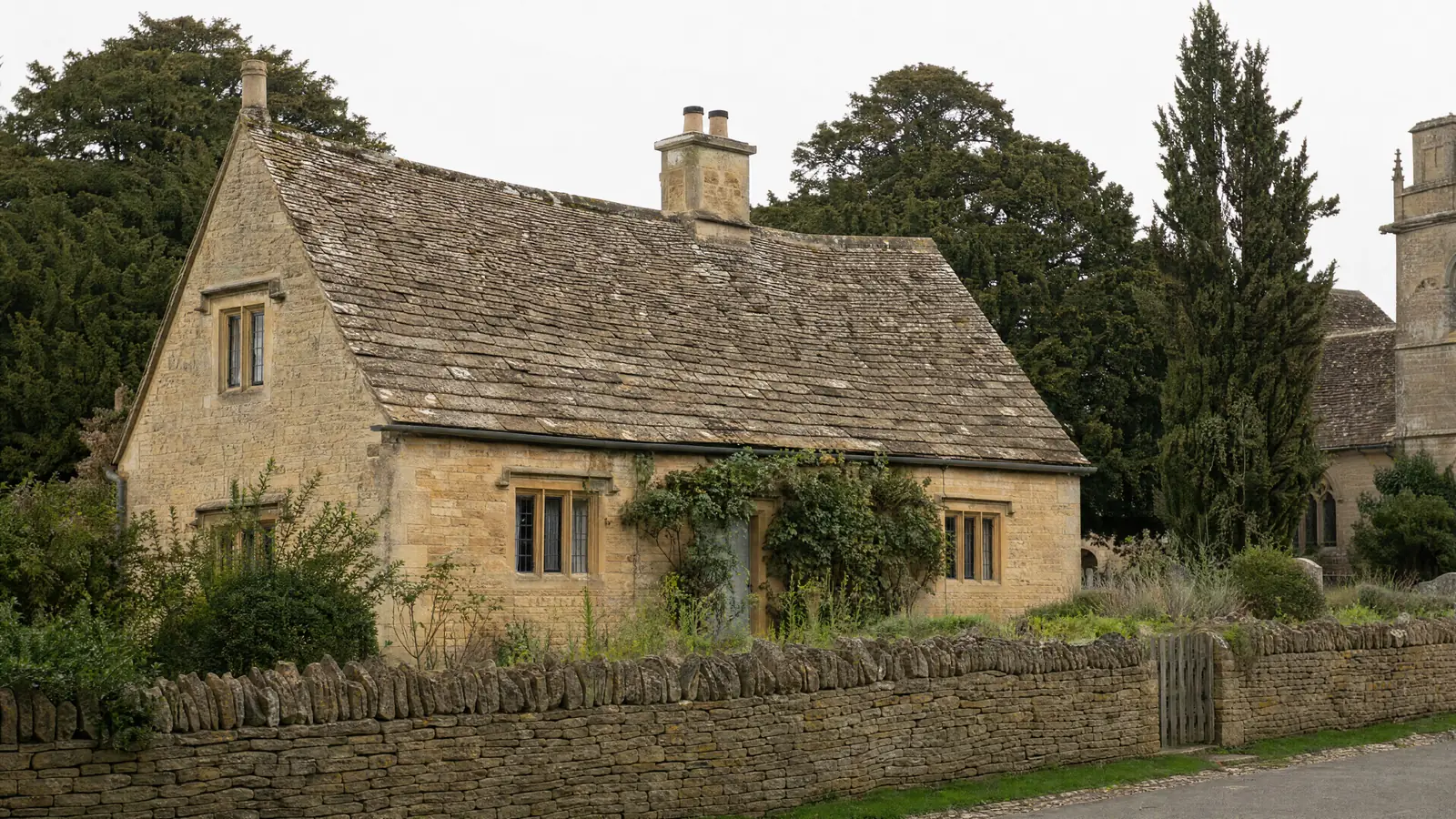
The look is unmistakable. A weathered Collyweston roof reads as a soft grey-brown varying stone by stone, it takes lichen readily, and because hand-split stone is not uniform in thickness the surface has texture and slight movement. That irregularity is not a defect. It is the material.
How it was won, and why that matters to you
This is not trivia. How the material was produced explains why it is scarce, why reclaimed stone is worth money, and why nobody can simply order more.
Open-cast working was established by 1633, and underground mining followed through narrow passages known as fox holes, which is where the term foxing for the process comes from. The stone came out as logs, which were laid out on beds of shale.
Then comes the part that makes it unusual. The splitting was done by frost, not by tools. Logs were laid out and watered, and frost drove the split along the natural bedding planes. That only works while the stone still holds its quarry moisture, so the working window was weather-dependent and effectively limited to about six weeks in December and January. Logs that missed the window were pied, buried in wet earth to hold the moisture in until the following winter.
A material with a six-week annual production window, dependent on hard frosts, was never going to survive competition from cheap imported Welsh slate arriving by rail. Production declined from the late 19th century and the industry was close to extinct by the 1970s.
So when a roofer talks about the value of your existing slates, that is not a sales line. Those stones represent something that was extremely difficult to make and cannot easily be replaced.
How the roof is actually put together
Diminishing courses
Collyweston is laid double lap in diminishing courses: the largest and heaviest slates at the eaves, each course above progressively smaller up to the ridge. The logic is practical, since the biggest stones sit where the structure is strongest and the water volume greatest, and visual, because it makes a roof read as taller and better proportioned.
It also means the slates are not interchangeable. Each course has its own size, and a slate taken from halfway up the slope cannot simply be dropped in at the eaves. That is the first reason a general roofer struggles here: the sorting and sizing is a craft in itself, and it is slow work for someone who has not done it before.
Pegs, laths and torching
Traditionally the slates are hung on riven laths by pegs rather than nailed through, and the underside was torched: a haired lime mortar applied between and around the slates from inside the roof space, to draught-proof the covering and help hold everything in position.
There is normally no felt in a traditional Collyweston roof. The construction relies on the lap, the torching and the roof space being able to breathe, which is why ventilation matters so much here and why sealing one up causes the problems below.
Why these roofs fail, and why it is almost never the slate
A Collyweston slate that has been on a roof for two hundred years will usually go back on for another hundred. The stone is rarely the thing that has failed. What fails is everything around it.
- The pegs. Timber pegs perish, and once a peg goes the slate slips. A run of slips across one slope normally means the pegs have reached the end of their working life, not that the stone has.
- The laths. Riven laths decay, particularly where the roof has been damp, and a decayed lath takes every slate hung on it with it.
- The torching. Lime torching falls away over time. Once it has gone the roof loses draught-proofing and some of its stability.
- The timbers. These are heavy roofs. If the structure has sagged, moved or rotted at the wall plate, that shows up in the covering long before anyone looks at the rafters.
Poor ventilation is the accelerant. A roof space that cannot breathe holds moisture, and that produces thermal cracking in the stone and moisture damage to the timbers. It is the most common way a well-meant modern improvement, insulating a loft without thinking about air movement, damages a historic roof.
The practical consequence is worth stating plainly. A comprehensive reroofing of a Collyweston roof means carefully removing the existing slates, redressing them and re-laying them on new laths and fixings. The stone is the asset. The job is everything underneath it.
Four repairs that permanently devalue a Collyweston roof
Each of these gets done regularly, often by people who believe they are helping.
1. Cement mortar
Cement is stronger, denser and far less permeable than the lime materials these roofs were built with. It traps moisture against the stone instead of letting it move and evaporate. On a bedding, a verge or a ridge, cement holds water where lime would release it, and the stone takes freeze-thaw damage as a result. It is also brutally difficult to remove from a slate without breaking it, which is where the loss of value comes in.
2. Spray-on foam
Foam sprayed onto the underside of a roof is sold as insulation, as stabilisation, or as a cheap alternative to re-roofing. On any traditional roof it stops the covering breathing and traps moisture in the timbers. On a Collyweston roof it does something worse: it bonds to the slates and makes them effectively unsalvageable. A roof full of reusable historic stone becomes a roof full of foam-covered rubble.
It causes problems well beyond roofing too. Lenders and surveyors take a dim view of sprayed foam, and it can complicate a sale.
3. Bituminous coatings
Painted-on bitumen products, sold as sealing or waterproofing a tired roof, do the same job from the other side. They trap moisture, they fail within a few years anyway, and they contaminate the stone so it cannot be cleaned and reused.
4. Stripping the roof into a skip
The least dramatic and possibly the most expensive. If a firm strips a Collyweston roof and takes the slates away, you have lost a genuinely scarce asset and will then pay for reclaimed stone to rebuild what you already owned. Any specification should state, in writing, that the existing slates remain your property and are set down, sorted and stored on site for reuse.
The common thread
All four trap moisture, and all four destroy the reuse value of the slates. If a firm proposes any of them on a stone slate roof, that is the end of the conversation with that firm.
The same logic applies to pressure washing. See roof cleaning and moss removal for why high-pressure water is a bad idea on any old covering, and a disaster on this one.
Reclaimed stone, and who should be on the roof
Because production declined from the late 19th century and the industry was nearly extinct by the 1970s, most Collyweston work depends on reclaimed slate: stone taken off other roofs, sorted, redressed and re-laid. Supply is finite, which is why your existing slates are worth protecting.
That also sets the pricing logic. On an ordinary re-roof, materials are ordered and the price is broadly predictable. Here, the availability of sound stone in the right sizes is a real constraint, and a job needing a lot of made-up slate is a different proposition from one where most of the original stone goes back.
Why a general roofer should not be up there
This is not snobbery about tradespeople. The skills are genuinely different, and the mistakes are not reversible.
- Sorting and sizing stone for diminishing courses is a craft that takes years to do quickly and correctly.
- Redressing slates without breaking them is a skill, and every broken slate is an irreplaceable one.
- Lime behaves nothing like cement. Mixing, timing and curing are all different, and lime is unforgiving of being rushed.
- These roofs are heavy and the stone is fragile at the edges, so access, loading and handling all differ.
- On a listed building, getting it wrong can be a criminal matter as well as an expensive one.
When you ask for quotes, ask specifically for firms that have done Collyweston work, ask which properties and where, and go and look at them from the road. Tell us it is a stone slate roof when you request quotes and the enquiry only goes to firms that handle that work. General tiling and slating is a different trade, and the villages page under areas we cover sets out where the two overlap.
Consent, the villages affected, and what it costs
Listed buildings and conservation areas
Many buildings carrying Collyweston roofs are listed, and most of the villages concerned are conservation areas. Work on a listed building requires the appropriate consent, and that can include work you would think of as straightforward repair.
Do not rely on this page and do not rely on your roofer. Ask Peterborough City Council before you commit to anything, and read conservation areas and listed buildings first so you know what to ask them.
Which villages this applies to
Historically Collyweston slate was used on almost all buildings within about ten miles of the quarries. In this district that means:
WansfordThornhaughBarnackPilsgateSouthorpeUffordBaintonHelpstonCastorAilsworthMarholm
Not every roof in those villages is stone, and stone roofs turn up outside them too. What matters is what is on your building, not the postcode.
What it costs
We publish guide ranges for most roofing work on this site. We do not publish one for Collyweston, and that is deliberate, because any figure we gave you would be invented.
Here is the reasoning instead, which is more useful than a made-up number. Heritage stone slate work sits well outside ordinary re-roof pricing, and the reasons are structural rather than a premium being charged for the postcode:
- It is hand work by nature. Removing, sorting, redressing and re-laying existing slates cannot be sped up.
- It is a specialist trade with few firms and a limited pool of skilled labour.
- Supply depends on reclaimed stone, and making up a shortfall is expensive and not always possible at any price.
- Lime mortars and torching take longer and are weather-dependent, and consent and conditions add time before and during the work.
- The structure underneath frequently needs attention once the covering is off, and nobody knows what is there until they get there.
Our cost guides state plainly that heritage materials, listed buildings and conservation area requirements sit outside the published figures. Treat a firm quoting a Collyweston roof at concrete-tile money as a warning rather than a bargain, because the saving is coming from somewhere.
The honest answer on cost is that it needs a survey and a written specification first, and a firm giving you a confident number over the phone has not understood the job. The checks in how to choose a roofer matter more here than anywhere else on this site.
Frequently asked questions
No. It is a fissile oolitic limestone of Jurassic age from Collyweston in Northamptonshire, about 12 miles from Peterborough. It splits along its bedding planes, which is what makes it usable as a roofing material.
True slate is a metamorphic rock. The two look different, weather differently and are laid differently, which is why a slater is not automatically a stone slater.
On a listed building, almost certainly not, and doing it without consent is an offence. In a conservation area it depends on the designation and on any Article 4 direction, so it is a question for Peterborough City Council rather than for a roofer.
Even where it is permitted, think about what you are giving up. The existing stone is a scarce asset and the substitution is effectively irreversible.
Almost always the fixings rather than the stone. Timber pegs perish and riven laths decay, and once either goes the slate has nothing holding it.
A few slipped slates in one area can be re-fixed. Slips appearing across a whole slope usually mean the pegs and laths have reached the end of their life, which points towards a comprehensive reroofing using the same stone.
Yes, genuinely. Production collapsed from the late 19th century and was close to extinct by the 1970s, so most work now depends on reclaimed stone.
Make sure any written specification states that the slates remain your property and are set down, sorted and stored on site for reuse. That one line protects real value.
It depends on whether the building is listed, whether it sits in a conservation area, and what exactly is being done. Listed building consent is required for works affecting the special interest of the building, and repair is not automatically exempt.
Ask Peterborough City Council before ordering materials. This site is general guidance, not planning advice.
Some can, and a straightforward re-fix by someone who understands pegs, laths and lime is a reasonable job. The risk is what gets used to do it.
Cement mortar, modern sealants or fixings driven through the stone cause damage that outlasts the repair. Ask what materials they intend to use before they start, and if the answer includes cement, stop.
No. It prevents the roof breathing, traps moisture in the timbers and bonds to the slates so they cannot be salvaged and reused.
It also causes difficulties with lenders and surveyors when you come to sell. Any firm proposing it on a traditional roof has told you what you need to know about them.
Historically the material was used on almost all buildings within about ten miles of the quarries, which in this district takes in Wansford, Thornhaugh, Barnack, Pilsgate, Southorpe, Ufford, Bainton, Helpston, Castor, Ailsworth and Marholm.
Not every building in those villages has a stone roof, and stone roofs exist outside them. What matters is the covering on your building.
Get quotes from Peterborough roofers
Tell us your postcode and what needs doing. We pass it to vetted roofing firms covering that part of Peterborough, and they come back to you directly with quotes.
- Takes about a minute
- No cost to you, ever
- You choose who to speak to, and you can say no to all of them
Compare Peterborough roofers
Answer four questions. We pass your job to vetted roofers who cover your postcode, and they come back to you with quotes. No charge, no obligation.
We pass your details only to roofing firms that cover your postcode, so they can quote. We never sell your details on for other purposes. See our privacy notice.
Find out what your roof should cost
Compare quotes from vetted Peterborough roofers, or call us and we will point you at the right sort of firm for the job.