Guides
Storm damage: what to do first, and who not to let on your roof
The first hour matters. The photographs matter more than people expect. And the person who knocks the next morning is often the biggest risk of the lot.
- The first hour
- Temporary cover
- What insurance covers
- Wear and tear refusals
- The knock at the door
- Why roofs fail here
- The permanent repair
The first hour, in order
- Get everyone away from the outside of the house, particularly below the damaged section. Tiles that have moved once will move again, and a slate falling two storeys is lethal. Do not stand in the garden photographing directly underneath loose material.
- Do not go into a room with a sagging or bulging ceiling. Shut the door and keep everyone out. Water sitting above plasterboard can bring the whole sheet down at once, without warning.
- Kill the power to any circuit where water is near lights, sockets or the consumer unit.
- Move what you can and contain the water. Electronics and documents out of the way, buckets and towels under the worst of it, something waterproof over anything that cannot be moved.
- Photograph everything before you touch anything. Wide shots, close-ups of the damage, the inside, and anything that has landed in the garden. Note the date and the storm. This is the most valuable ten minutes you will spend and the step people skip because they are stressed.
- Call your insurer's emergency line before commissioning anything expensive, provided that does not mean letting water pour in for hours. Most policies have a 24-hour line and many will authorise emergency work.
- Get temporary cover organised. If water is coming in, this comes before quotes, before comparisons and before anyone's paperwork.
- Do not go on the roof. Not in the dark, not in the wind, not the next morning. See emergency roofing.
If it is dangerous, it is not your job
Tiles hanging over a pavement, a chimney that has visibly moved, a lifted roof section, or anything at risk of falling onto a road or a neighbour is a call to the emergency services or the council, not something to manage yourself.
If a chimney stack looks out of plumb, treat the rooms below it as out of use until somebody competent has looked at it.
Temporary cover: what it actually is, and what it should cost
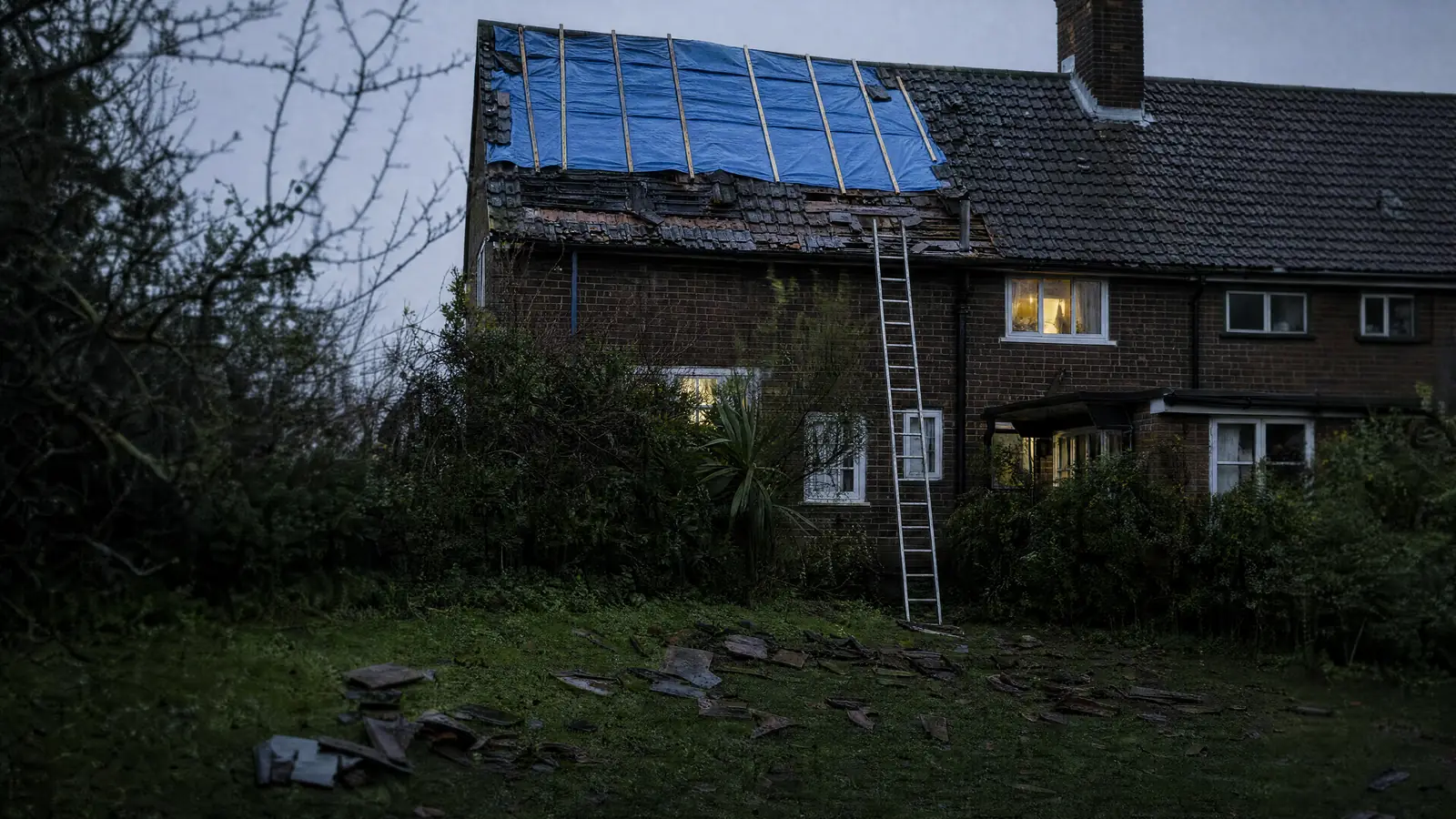
Temporary cover, usually called a tarp, is a heavy-duty sheet fixed properly over the damaged area with battens, so it stays put in the next round of wind and directs water off the roof rather than trapping it behind. It is not a bin bag and tape, and it is not a permanent fix.
Done properly it needs safe access, and access is the expensive part. On a bungalow or a single-storey extension a competent roofer may manage from a ladder or a tower. Two storeys up in wind, it is scaffolding or nothing.
Emergency call-out pricing is legitimately higher than planned work, because somebody is dropping other jobs and working in bad conditions. What is not legitimate is a four-figure number for a sheet over a hole, or a firm that will only sheet the roof if you sign for the permanent work at the same time. Those are two separate decisions and you are entitled to keep them separate.
- Ask what the cover costs as a standalone job, in writing or by text, before anyone starts.
- Ask whether that cost comes off the permanent repair if you use the same firm. Many will say yes. Get that in writing too.
- Ask how long it is expected to last. Weeks is normal, a whole winter is optimistic.
- Photograph the damage before the cover goes on. Once it is sheeted, your evidence has gone.
- Keep the receipt. Emergency work to prevent further damage is normally recoverable on a claim.
What buildings insurance actually covers
Buildings insurance normally covers storm damage. The argument is almost never about whether storm damage is covered. It is about whether what happened to your roof counts.
What a typical policy covers
- Damage to the structure caused by a storm, usually defined by wind speed and sometimes extending to heavy snow or torrential rain.
- Resulting water damage inside, such as ceilings and decoration. Contents sit under a separate section if you have one.
- Reasonable emergency work to prevent further damage, which is why you keep the temporary cover receipt.
What it usually does not
- Gradual deterioration. Insurance is for sudden events, not maintenance.
- Damage to a roof already in poor condition, on the argument that the storm revealed the problem rather than caused it.
- Fences, gates and sometimes outbuildings, frequently excluded or capped.
- The excess, which on some policies is higher for storm claims.
Read the actual policy wording rather than the summary document. The definition of storm in your policy is the thing the entire claim turns on.
Wear and tear: the reason most claims get refused
Wear and tear is the commonest refusal, and it is worth understanding rather than treating as insurers being awkward. Their position is that if a roof was already at the end of its life, the storm did not cause the loss, it exposed it. On a 55-year-old township roof still carrying its original covering and original nails, that argument has some force. It also gets applied lazily to roofs where it does not apply at all.
What actually decides it
Two things: your photographs, and how the roofer's report is worded.
- Dated evidence, before and after. Any older photograph showing the roof intact is worth a great deal. Failing that, photographs taken immediately after the storm establish the event.
- A report that describes cause, not just condition. A report saying the roof is old, the tiles are worn and a re-roof is recommended hands the insurer its refusal. A report identifying which components failed, in which direction, consistent with wind loading on a named date, and confirming the surrounding covering is otherwise sound, is a completely different document.
- The storm itself. Give the date, and the name of the storm if it had one. Weather records are public and the insurer will check them anyway.
- Consistency. Your account, the photographs and the report should describe the same event. Contradictions get seized on.
Ask a roofer directly whether they are used to writing reports for insurance claims. Plenty are, and it makes a genuine difference. It is also reasonable for them to charge for the report separately.
If the claim is refused
Ask for the decision in writing with the specific policy clause relied on, get an independent roofing report addressing cause, and use the insurer's complaints process. If that fails, the Financial Ombudsman Service handles complaints about insurers free of charge. A first refusal is not the end of the matter.
The knock at the door
After every serious storm, a predictable set of people work door to door across the affected streets. Not all of them are dishonest. Enough are that the pattern is worth knowing cold.
The pattern
- I noticed from the road that you have tiles missing. Nobody drives past and diagnoses a roof. They are looking for houses to approach, and older residents in particular get targeted.
- We are working round the corner and have materials left over. There is no job round the corner.
- I can go up now and take a look, no charge. Once somebody uninvited is on your roof you have lost control, and damage gets created as well as found.
- If we leave it the ceiling will come through. Manufactured urgency, applied hardest to anyone who seems anxious or alone.
- Cash today and I can do it for half. No paper trail, no invoice, no comeback. And no legitimate roofer needs your decision inside the hour.
- A mobile number and no address on the vehicle, and paperwork with no company registration number on it.
Your cancellation rights
Most people do not know this. When you agree a contract at your home rather than at a trader's premises, consumer law normally gives you 14 days to cancel, for contracts above a low value threshold, and the trader must tell you about that right in writing. Where they fail to, the cancellation period is extended substantially and the failure is an offence in itself.
There is a specific trap. If you ask for work to start inside the cancellation period and sign to that effect, you can still cancel but may have to pay for what has genuinely been done. That is what doorstep traders rely on: get a signature, start immediately, then claim for a part-finished job.
If you have already paid and it has gone wrong, contact Citizens Advice, who pass reports to Trading Standards. Payments over £100 by credit card may carry additional protection through the card provider.
- Never let anyone onto your roof who arrived uninvited.
- Never pay cash up front to somebody who knocked on your door.
- Never sign anything on the doorstep on the day.
- If they are genuine, they will still be genuine tomorrow. Take the details and check them, or approach firms yourself instead. Our quote comparison is one way to do that, and how it works explains exactly what happens to your details.
Why roofs here fail at the ridge and the verge
Peterborough sits on the fen edge, which is flat and wind-exposed. There is very little hill, woodland or dense terrain to slow wind down before it reaches your roof, and that shows in the pattern of what fails.
Wind damage to a pitched roof is mostly an uplift problem rather than a push problem. Air accelerating over the ridge creates suction, and the highest loads occur at the edges: the ridge, the verges at the gable ends, the hips and the eaves. That is why storm damage so often starts at precisely those points rather than mid-slope.
What tends to go first
- Ridge tiles. Traditional ridges are bedded in mortar, mortar lets go over decades, and once one ridge tile lifts the wind gets under the rest. Dry ridge systems are mechanically fixed and hold up far better.
- Verges and hips. The mortar edge at a gable end is the most exposed line on the roof, and cement verge pointing on township-era housing is well past its best. Hips are the same problem on the diagonal.
- Felt at the eaves. Wind-driven rain gets under lifted tiles, and the eaves felt is the last defence before the wall plate.
- Flashings. Lead that has lost its clips or wedges lifts, and once lifted it stays open.
Two things follow. First, if a storm has taken one ridge tile, get the whole ridge inspected rather than that single tile replaced, because the mortar holding the rest is the same age. Second, the money in storm-proofing a roof here is at the edges. Guide pricing for repointing or replacing ridge tiles runs from around £450 to £1,200 depending on the length of the ridge and whether it is redone in mortar or as a dry ridge system. See roofing costs.
From temporary cover to a permanent repair
Once the water is stopped the pressure is off, and that is the point to slow down rather than speed up.
- Get the temporary cover on, same day if water is coming in.
- Notify the insurer even if you are not certain you will claim. Late notification is itself a reason claims get reduced.
- Get the damage assessed and photographed, and if you are claiming, get a report worded around cause.
- Get two or three quotes. Storm work is exactly when people accept the first number because they are shaken, and exactly when they should not.
- Check the whole roof while there is access. If a scaffold is going up anyway, dealing with the rest of the ridge, the verges and the flashings costs little next to doing it separately in two years.
- Only then agree the work in writing, with materials and guarantee specified.
If the storm has exposed a covering that is genuinely finished, that is a different and larger conversation. Our guide ranges put a full re-roof on a terraced house at roughly £5,500 to £9,500 and a semi-detached at £7,000 to £13,000, and the cost guides set out what moves those figures.
For the work itself see roof repairs, and for the stack chimney repairs. In a conservation area or on a listed building, read conservation areas and listed buildings before agreeing materials, because like for like is not always your decision to make. And the checks in how to choose a roofer are worth more after a storm than at any other time.
Frequently asked questions
Usually yes, where the damage was caused by a sudden storm event. What is commonly excluded is damage to a roof that was already worn out, on the argument that the storm revealed the problem rather than caused it.
Emergency work to prevent further damage is normally recoverable too, so keep the receipt for any temporary cover.
It depends on your policy, and this is the detail worth checking before you claim. Many insurers use a stated wind speed threshold, some also include heavy snow or torrential rain, and some leave it looser.
Weather records for the date are public and the insurer will check them, so give the exact date and the name of the storm if it had one.
If water is actively coming in, yes. Policies expect you to take reasonable steps to prevent further damage, and doing nothing while you wait on hold can count against you.
Call the emergency line if you can, keep the cost proportionate, and keep the receipt and the photographs.
Thank them, take no action, and do not let them on the roof. If you are genuinely worried, look from the ground yourself or from an upstairs window at a neighbouring property, and then get a firm you approached yourself to look.
Nobody diagnoses a roof from a moving vehicle. If material is at risk of falling onto a road or a pavement, that is a call to the council or the emergency services, not to the person on your doorstep.
Normally yes. Contracts agreed away from a trader's business premises usually carry a 14 day cancellation period, and the trader has to give you written notice of that right. Where they fail to, the period is extended.
If work has already started at your request you may owe for what has genuinely been done, which is why signing to start immediately is the thing to avoid. Citizens Advice can confirm where you stand on your specific contract.
No. Ask for the refusal in writing with the specific policy clause relied on, then get an independent roofing report that addresses cause rather than condition, and go through the insurer's complaints process.
If you are still unhappy, the Financial Ombudsman Service reviews complaints about insurers free of charge.
In practice most people claim on their own buildings insurance and let the insurers deal with it. Recovering the cost from a neighbour generally depends on showing they were negligent, for example that they knew the roof was dangerous and did nothing, rather than simply that the tile came from their house.
Storm damage is usually treated as nobody's fault. This is general guidance rather than legal advice, so take proper advice if the sums are significant.
After a widespread storm every roofing firm in the city is fielding calls at once, so temporary cover within a day or two and a permanent repair some weeks later is a realistic expectation.
Flag the job as an emergency when you get in touch, because genuine water ingress gets prioritised over inspections and estimates.
Get quotes from Peterborough roofers
Tell us your postcode and what needs doing. We pass it to vetted roofing firms covering that part of Peterborough, and they come back to you directly with quotes.
- Takes about a minute
- No cost to you, ever
- You choose who to speak to, and you can say no to all of them
Compare Peterborough roofers
Answer four questions. We pass your job to vetted roofers who cover your postcode, and they come back to you with quotes. No charge, no obligation.
We pass your details only to roofing firms that cover your postcode, so they can quote. We never sell your details on for other purposes. See our privacy notice.
Find out what your roof should cost
Compare quotes from vetted Peterborough roofers, or call us and we will point you at the right sort of firm for the job.