Roofing services
Guttering, fascias and soffits in Peterborough
The least glamorous line on any roofing quote, and pound for pound the one that prevents the most expensive damage.
Cheap work, expensive consequences
A blocked or broken gutter costs almost nothing to deal with and it is the thing most reliably ignored until it has caused damage worth several thousand pounds.
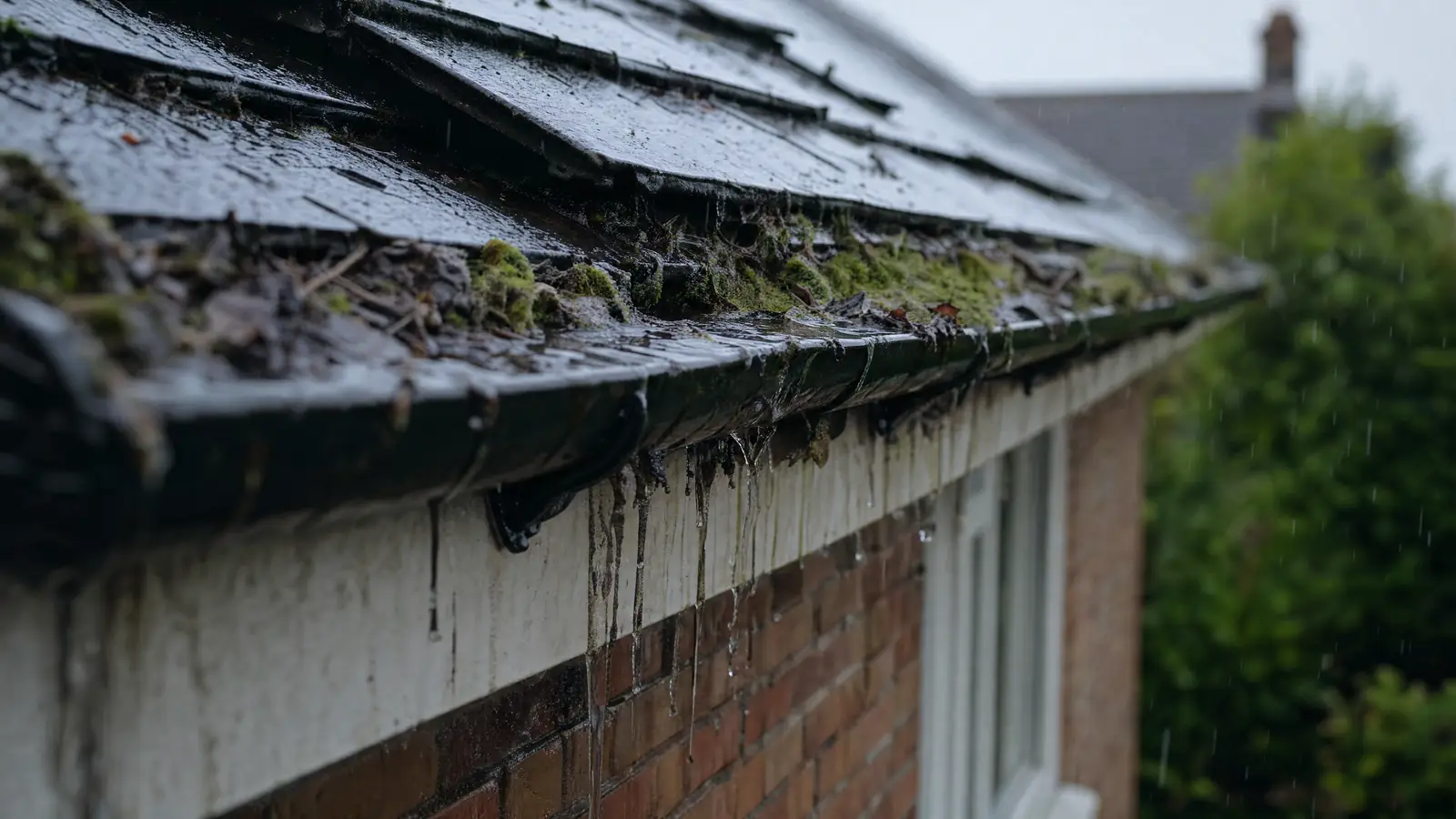
Here is the chain. The gutter fills or splits. Water runs down the wall instead of into the drain. The wall saturates, which shows up inside as damp on the internal face, usually blamed on rising damp, condensation or a leaking roof. Our roof leaks guide covers how often guttering turns out to be the answer. Meanwhile water is also getting behind the gutter onto the fascia board, which rots. The fascia is what the gutter is screwed to and what the rafter feet are protected by, so once it goes soft the gutter starts pulling away and the rafter ends begin to take water directly.
By the time anybody looks at it properly, a £180 gutter clearance has become a fascia replacement, rafter end repairs, a re-plastered internal wall and, if it has run long enough, timber treatment. None of that needed to happen.
- Clear the gutters at least once a year, and twice if there are trees near the house
- Look at them during heavy rain, not on a dry day. Overflow and leaks only show when they are working
- Water staining down a wall below a joint is a failed joint, not a porous wall
- Green algae streaks under a gutter joint mean it has been leaking for a long time
- Plants growing in a gutter means it has not been cleared in years
The parts, and what each one does
- Fascia. The board fixed across the ends of the rafters along the eaves. It carries the gutter and it closes off the rafter ends. Structurally it is doing more than people assume.
- Soffit. The horizontal board underneath, closing the gap between the fascia and the wall. It keeps birds and wasps out of the roof space, and on most modern roofs it is also where the loft ventilation comes in.
- Bargeboard. The equivalent of a fascia running up the slope of a gable end. More exposed than anything else on the eaves and usually the first timber to go.
- Gutter and downpipe. Collects and drops the water. Half round and square are the common domestic profiles, and mixing brands rarely works because the joints are not compatible.
- Over-fascia vent and eaves protector. Small plastic components that keep the underlay running into the gutter rather than sagging, and maintain the ventilation gap. Cheap, frequently omitted, and their absence causes rotted underlay at the eaves.
On the older properties around Millfield and New England the original fascias and bargeboards are timber and the gutters were cast iron. Cast iron is heavy, it lasts a very long time if it is painted, and it rusts from the inside out if it is not. Replacing it with uPVC is normal, but in a conservation area the appearance of the front elevation may be controlled, so check the conservation areas guide first.
uPVC, aluminium or timber
uPVC
The default, and for most houses the right answer. It does not rot, it does not need painting, and a full replacement in uPVC on an ordinary semi is comfortably the cheapest route. The downsides are honest ones: white uPVC discolours over a couple of decades, it looks like what it is on a period building, and cheap thin-gauge board sags between fixings.
Ask what thickness the fascia board is. There is a real difference between a proper replacement board and a thin one, and it is not visible on the quote.
Aluminium
Usually seamless, rolled on site to the exact length of the elevation so there are no joints to fail across the run. That is the main argument for it, because gutter joints are where gutters leak. Powder coated finishes hold their colour far better than uPVC, it is rigid, and it has a long life.
It costs meaningfully more and there are fewer installers, so it is worth pricing against uPVC rather than assuming. On a long, awkward or high elevation where nobody wants to be going back up to a leaking joint, it earns its money.
Timber and cast iron
Correct on a listed building or a period property in a conservation area, and expensive to maintain everywhere else. If you are keeping timber, it needs painting on a cycle and it needs the rafter feet behind it to be sound.
Capping over rotten timber
The job to watch for is capping, sometimes sold as over-cladding: a thin uPVC cover board screwed straight over the existing timber fascia rather than replacing it.
It is a legitimate technique where the timber underneath is genuinely sound and being protected. It is a con when the timber is already rotten, because you have now sealed wet wood behind plastic and it will carry on rotting out of sight, taking the rafter ends with it.
Ask directly whether the existing boards are being removed or capped, and ask them to show you the condition of the timber before they cover it. There are more questions like that in how to choose a roofer.
The ventilation point nobody mentions
This is the part of the job that gets quietly wrong most often, and it causes damage that looks like a roof leak but is not.
A conventional cold loft needs air moving through it. Warm, moist air from the house rises into the roof space and, without ventilation, it condenses on the cold underside of the underlay and drips back onto the insulation and the ceiling below. Householders find damp patches, damp insulation and sometimes mould on the rafters, call a roofer about a leak, and there is no leak to find.
The ventilation usually comes in at the eaves, through the soffit, and the accepted rule of thumb is a continuous 10mm equivalent gap along both eaves for most pitched roofs, or 25mm for shallower pitches and some room-in-roof arrangements. It gets delivered by ventilated soffit board, circular soffit vents or over-fascia vents.
The failure mode is straightforward. Somebody replaces the fascias and soffits with solid board and does not put the vents back. Or somebody insulates the loft enthusiastically and pushes the insulation right into the eaves, blocking the airflow. Either way the loft stops breathing and starts sweating, usually within a winter or two.
- Ask specifically whether the new soffits are vented and how much ventilation is being provided
- If the loft has been re-insulated recently, check the insulation is not jammed into the eaves
- Damp in a loft with no stain on the underside of the underlay is condensation, not a leak
- A breathable underlay helps but it is not a substitute for eaves ventilation
Guttering and fascia guide prices in Peterborough
| Job | Guide range | What moves it |
|---|---|---|
| Clear and flush gutters, semi-detached | £90 to £180 | Height, access, and how much is in them |
| Repair or replace a leaking gutter joint | £90 to £220 | Access, and whether the profile is still available |
| Replace guttering only, one elevation | £250 to £600 | Run length, uPVC or aluminium, downpipe changes |
| Replace fascias, soffits and gutters, semi | £1,800 to £3,800 | Run length, and whether the roof edge needs work behind them |
| Replace fascias, soffits and gutters, detached | £2,600 to £5,500 | Total run, bargeboards, number of storeys, scaffold |
| Seamless aluminium guttering, per metre | £45 to £85 | Access, profile, colour, and the number of outlets |
| Rafter end repair, per rafter | £70 to £160 | Added where timber behind the fascia has rotted |
Guides only, not quotes. Cast iron replacement on a period property and conservation area requirements sit outside these figures. See the full Peterborough cost table.
Do it while the scaffold is up
On a lot of roofing jobs the scaffold is the largest single line, and it costs the same whether one trade uses it or three. That single fact should shape how you plan roof work.
If a re-roof is happening, that is the moment to replace the fascias, soffits and gutters, sort the chimney flashing and deal with the bargeboards. Doing them separately over the following five years means paying for access three times, and each of those access charges can rival the cost of the work itself.
It also produces a better roof. Fitting a new eaves detail, over-fascia vent and underlay support at the same time as the new underlay goes on is a proper job. Retro-fitting a fascia under a roof that was finished two years ago is a compromise.
When you fill in the quote form, say what else you are thinking about. Roofers will price the lot, and the combined figure is usually a long way below the sum of the separate ones.
Frequently asked questions
As a July 2026 guide including VAT, £1,800 to £3,800 for a semi-detached house and £2,600 to £5,500 for a detached, in uPVC.
Aluminium costs more, and rotten rafter ends found behind the old boards add roughly £70 to £160 per rafter. A quote with no allowance for that is a quote that will change.
Once a year as a minimum, and twice a year if there are trees close to the house. Autumn is the important one.
Clearing costs £90 to £180 for a semi as a guide, which is trivially cheap against the cost of a saturated wall and a rotted fascia.
Only if the timber underneath is genuinely sound. Capping means screwing a thin uPVC cover board over the existing fascia rather than replacing it.
Over rotten timber it is a con. You seal wet wood behind plastic, it carries on rotting where nobody can see it, and it takes the rafter ends with it. Ask to be shown the condition of the boards before anything is covered.
On a conventional cold loft, yes. The usual rule of thumb is a continuous 10mm equivalent gap along both eaves, or 25mm for shallower pitches.
Fitting solid soffit board with no vents is a common and damaging mistake. The loft stops breathing, condensation forms on the underside of the underlay and it looks exactly like a roof leak. Our roof leaks guide covers how to tell the two apart.
On a long, high or awkward elevation, often yes, because it is rolled seamlessly on site and gutter joints are where gutters leak.
On an ordinary semi where access is easy, uPVC does the job at a lower price. It is worth getting both priced rather than assuming either way.
Usually a failed joint, a gutter that has dropped out of level, or an overflow at the back of the gutter where it meets the fascia.
Look during heavy rain rather than on a dry day. Most gutter faults are invisible when nothing is running through them.
Get quotes from Peterborough roofers
Tell us your postcode and what needs doing. We pass it to vetted roofing firms covering that part of Peterborough, and they come back to you directly with quotes.
- Takes about a minute
- No cost to you, ever
- You choose who to speak to, and you can say no to all of them
Compare Peterborough roofers
Answer four questions. We pass your job to vetted roofers who cover your postcode, and they come back to you with quotes. No charge, no obligation.
We pass your details only to roofing firms that cover your postcode, so they can quote. We never sell your details on for other purposes. See our privacy notice.
Find out what your roof should cost
Compare quotes from vetted Peterborough roofers, or call us and we will point you at the right sort of firm for the job.